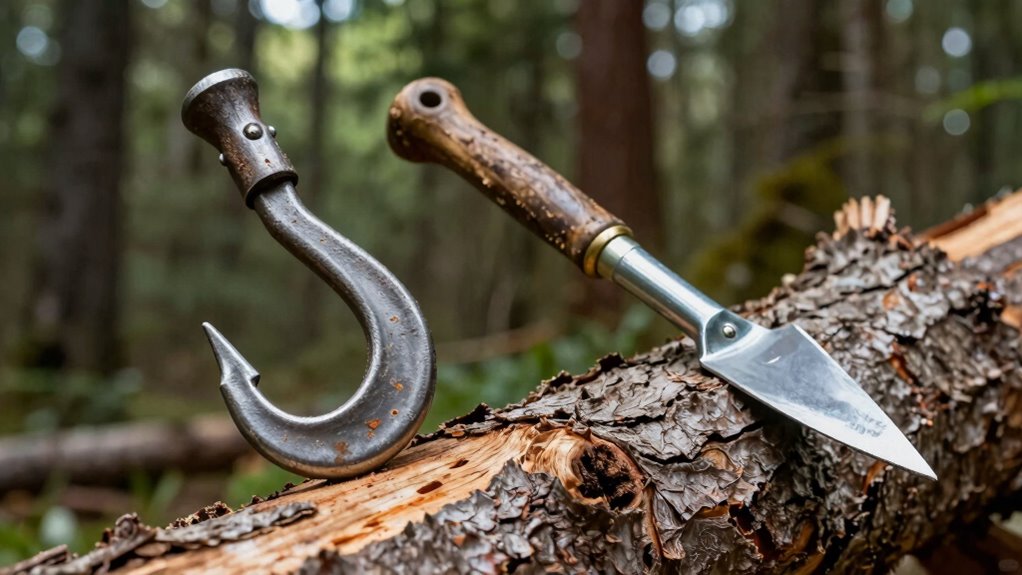

When choosing between a cant hook and a peavey, consider the task. Use a cant hook when you need precise, controlled movements with a secure grip, ideal for repositioning logs carefully. Opt for a peavey when lifting or dragging heavier logs, especially from difficult spots, thanks to its leverage and reach. Understanding each tool’s strengths helps you work efficiently and safely—for those details, explore what makes each tool excel.
Key Takeaways
- Choose a cant hook for precise, controlled log repositioning and secure grip during steady movements.
- Opt for a peavey when lifting, pulling, or pivoting heavy logs, especially from difficult or uneven terrain.
- Use a cant hook for delicate handling requiring grip strength and secure latching.
- Select a peavey for leverage and reach to handle larger, heavier logs with less physical effort.
- The best tool depends on whether your priority is grip control (cant hook) or leverage and durability (peavey).

When it comes to handling logs and performing heavy lifting in woodworking or forestry work, choosing the right tool can make a significant difference. Both cant hooks and peaveys are essential tools, but understanding which one excels in specific situations can save you time and effort. Your decision should consider factors like grip strength and tool durability, which directly impact performance and safety.
Choosing the right log-handling tool depends on grip strength and durability needs.
A cant hook is designed with a curved hook at the end of a sturdy handle, often featuring a gripping mechanism like a lever or latch. This design emphasizes grip strength, allowing you to securely latch onto logs and maneuver them with precision. Because of its focus on grip, a cant hook is ideal for tasks that require controlled, steady movements, such as rolling or repositioning logs. Its robust construction ensures durability, making it suitable for repeated heavy use in demanding environments. If you’re working with large, stubborn logs that need to be moved carefully without slipping, a cant hook’s reliable grip and durable build make it the better choice.
On the other hand, a peavey features a longer handle with a pointed hook and often includes a sharpened spike or blade at the end. The design gives it a leverage advantage, enabling you to lift, pivot, or drag logs efficiently. While grip strength is still important, the emphasis with a peavey is on leverage and reach, allowing you to handle larger or heavier logs with less physical strain. Its tool durability is also notable; peaveys are built to withstand rugged use, especially in rough terrain where the spike might encounter rocks or uneven surfaces. If your work involves lifting logs from the ground or pulling them over obstacles, the peavey offers the leverage and durability needed for such tasks.
Ultimately, each tool wins in different scenarios. When you need precise control and a secure grip to manipulate logs delicately, the cant hook is your best bet. Conversely, if your job involves lifting heavy logs from challenging positions or over obstacles, the peavey’s leverage and rugged durability will serve you better. Both tools are built tough, but their specialized features cater to distinct aspects of log handling. Knowing when to use each can streamline your workflow, reduce fatigue, and improve safety. Additionally, modern AI-powered tools are increasingly being integrated into forestry work to optimize efficiency and safety. So, assess your needs carefully, considering grip strength and tool durability, and you’ll select the right tool for the job every time.

Timberjack Log Roller Lifter, 50.8" Long Handle Log Roller Tool
- Material: Heavy-duty carbon steel construction
- Finish: Black powder-coated surface for rust resistance
- Adjustability: Adjustable cant hook for logs 3-25 inches
As an affiliate, we earn on qualifying purchases.
As an affiliate, we earn on qualifying purchases.
Frequently Asked Questions
Can a Peavey Replace a Cant Hook Entirely?
A peavey can’t fully substitute a cant hook because, in wood handling, tool versatility is key. While a peavey is great for prying and moving logs, a cant hook offers better control for rolling and positioning. You’ll find that each tool excels in different tasks, so using both ensures you handle wood efficiently and safely. Relying solely on a peavey limits your versatility in various log handling situations.
Which Tool Is Safer for Beginners?
For beginners, a Peavey is generally safer because it offers better ergonomic design and easier control, reducing the risk of accidents. Safety considerations like a comfortable grip and manageable weight help you handle it confidently. A cant hook, while effective, may require more skill to operate safely, especially for those new to logging tools. So, for safety and beginner ergonomics, the Peavey is usually the better choice.
How Do Maintenance Needs Differ Between the Two?
You’ll find that maintenance needs differ mainly in blade durability and grip comfort. With a Peavey, you might need to sharpen or replace the blade more often due to frequent use, especially on tough wood. A cant hook generally requires less blade upkeep but benefits from regular handle checks to maintain grip comfort. Keep both tools clean and store them properly to prolong their lifespan and make certain of safe, effective use.
Are There Specific Wood Types Suited for Each Tool?
Imagine gripping a sturdy tool, feeling its perfect balance in your hand. For wood compatibility, a cant hook excels with softer, seasoned woods like cedar or pine, thanks to its gripping teeth. The peavey handles denser woods like oak or hickory better, offering superior leverage. Tool ergonomics also matter—choose the cant hook for easier maneuverability on lighter wood, while the peavey’s design suits heavier, tougher logs.
Can I Use Both Tools Together Effectively?
Yes, you can use both tools together effectively, thanks to their dual tool versatility. Combine the cant hook’s grip with the peavey’s leverage to handle different wood types and sizes efficiently. Just keep ergonomic design considerations in mind—use proper stance and grip to reduce fatigue and injury. This approach maximizes their strengths, making your work smoother and more efficient, especially when tackling challenging logs or varied wood conditions.
Conclusion
When choosing between a cant hook and a peavey, think of it like selecting the right tool for a specific job. I once watched a seasoned logger effortlessly lift a heavy log with a peavey, like a skilled juggler handling flaming torches. That moment showed me how the right tool makes all the difference. Whether you need precision or power, knowing each tool’s strength will help you handle logs with confidence and ease.


![There Will Come Soft Rains (1950) [Pdf]](https://woodsplittersdirect.com/wp-content/uploads/2026/08/there-will-come-soft-rains-1950-pdf-featured-260x140.jpg)