
Get business pricing on tools and workshop supplies
- Business-only prices and quantity discounts
- Tax-exempt purchasing
- Multiple users, one account, clear invoices
At a Glance
| Criteria | Compact Electric Log Splitter | Heavy-Duty Electric Log Splitter | Winner |
|---|---|---|---|
| Splitting Force (tons) | 5-7 tons | 10-20 tons | B |
| Portability | Lightweight, compact | Heavier, less portable | A |
| Price | Lower cost | Higher cost | A |
| Ease of Use | Simple controls, lightweight | More complex controls | A |
| Safety Features | Basic safety features | Advanced safety features | B |
| Build Quality | Good for light use | Heavy-duty build | B |
| Log Capacity | Up to 12 inches diameter logs | Up to 24 inches diameter logs | B |
| Maintenance | Minimal maintenance | Regular maintenance needed | B |
BILT HARD 6.5 Ton Electric Log Splitter with Hydraulic Ram

<p>The <strong>BILT HARD 6.5 Ton Electric Log Splitter</strong> stands out for its combination of power and portability. With a 15Amp motor delivering 6.5 tons of force, it handles logs up to 9.8 inches in diameter with ease. Its fast cycle time of 18 seconds boosts productivity, making it suitable for frequent firewood prep. Compared to larger models, its compact size and transport wheels make it manageable for most DIYers, though it’s limited to smaller logs and requires a robust electrical circuit. Heavy at nearly 98 pounds, it might be less convenient to move often, but its safety features and durable steel build make it a reliable choice for many.</p>
BILT HARD 6.5 Ton Electric Log Splitter with Hydraulic Ram
- ✔ Motor Power: 15 Amps
- ✔ Splitting Force: 6.5 Tons
- ✔ Max Log Diameter: 9.8 inches
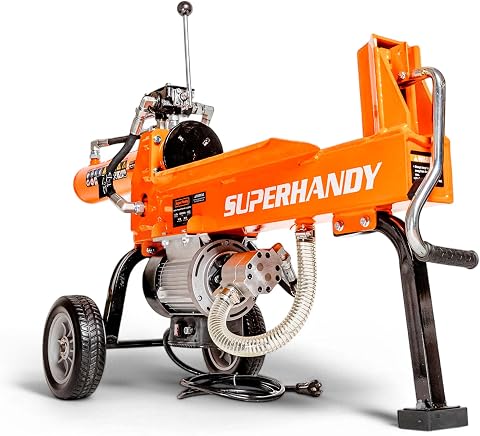
SuperHandy Hydraulic Log Splitter, 14 Ton, Portable Firewood Splitter
- ✔ Motor Power: 2.5 HP 1800W
- ✔ Hydraulic System: 2-Stage 10.5 GPM Bucher Hydraulic Gear Pump
- ✔ Splitting Capacity: Logs up to 20" long and 14" in diameter

YARDMAX YS0650 6.5 Ton Electric Log Splitter
- ✔ Ram Force: 6.5 Ton
- ✔ Log Capacity Length: 20.5 inches
- ✔ Log Capacity Diameter: 10 inches
Pros:
- Powerful 6.5-ton splitting force
- Fast cycle time for quick work
- Portable with transport wheels
- Safety features like two-hand controls
Cons:
- Limited to logs up to 9.8 inches diameter
- Requires a 40-amp circuit breaker
- Heavy and somewhat difficult to move frequently
Best for: DIYers needing a portable, efficient splitter for smaller logs and routine firewood tasks
Not ideal for: Those needing to split very large logs or requiring ultra-lightweight equipment
Bottom line: A solid all-around choice for DIYers who want reliable power in a portable package, with some capacity limitations.
“A solid all-around choice for DIYers who want reliable power in a portable package, with some capacity limitations.”
SuperHandy Hydraulic Log Splitter, 14 Ton, Portable Firewood Splitter
<p>The <strong>SuperHandy 14-ton hydraulic splitter</strong> is a powerhouse designed for tackling larger, tougher logs up to 14 inches in diameter and 20 inches long. Its 2.5 HP electric motor and hydraulic gear pump deliver exceptional force, making it suitable for serious firewood preparation. Its portability is enhanced by transport wheels, and it operates quietly at around 65dB, making it suitable for outdoor or indoor use. However, hydraulic fluid isn’t included, and setup requires manual safety precautions. Its weight of 126 lbs means assistance is recommended for moving it around, but its high capacity makes it a favorite for demanding DIY projects.</p>
Pros:
- Massive 14-ton splitting force
- Capable of handling large logs up to 20 inches long and 14 inches diameter
- Quiet operation and eco-friendly
- Portable with transport wheels
Cons:
- Hydraulic fluid not included, additional cost and setup needed
- Heavy and requires assistance for transport
- Manual setup and safety measures required
Best for: DIYers with large logs and demanding splitting needs who can handle setup and maintenance
Not ideal for: Users seeking a lightweight, plug-and-play solution for smaller logs or casual use
Bottom line: This model makes the most sense for serious DIYers with large logs and space for setup, offering unmatched force but requiring more effort to operate safely and effectively.
“This model makes the most sense for serious DIYers with large logs and space for setup, offering unmatched force but requiring more effort to operate safely and effectively.”
YARDMAX YS0650 6.5 Ton Electric Log Splitter
<p>The <strong>YARDMAX YS0650</strong> offers a straightforward, electric solution for DIYers who prioritize ease of use and maneuverability. With a 6.5-ton ram force, it efficiently handles logs up to 20.5 inches long and 10 inches in diameter. Its lighter weight of approximately 105 pounds makes it easier to transport and store, especially for those with limited space or less strength. While it shares similar capacity to the BILT HARD model, it is slightly more user-friendly for quick setups. Its main tradeoff is a slightly lower capacity for very large logs, and it lacks adjustable settings for splitting speed, making it less suited for high-volume or very tough splitting jobs.</p>
Pros:
- Lightweight and portable
- Capable of handling logs up to 20.5 inches long and 10 inches in diameter
- Electric operation provides clean and quiet performance
- Durable build for regular DIY use
Cons:
- Heavy weight still requires assistance for transport
- Limited capacity for extremely large logs
- No multiple splitting speed options
Best for: DIYers seeking an easy-to-maneuver, electric splitter for moderately large logs
Not ideal for: Those who need to split very large or tough logs regularly or require multiple speed settings
Bottom line: An excellent choice for casual or intermediate DIYers who want a reliable, easy-to-use splitter that balances power and portability without the complexity of hydraulic systems.
“An excellent choice for casual or intermediate DIYers who want a reliable, easy-to-use splitter that balances power and portability without the complexity of hydraulic systems.”
As an Amazon Associate we earn from qualifying purchases.
Key Differences
The core difference between these two options is in their power and capacity. The compact model offers enough force for small to medium logs, making it suitable for occasional DIY use and easy storage. However, its lower power limits its ability for large or tough logs. The heavy-duty model provides significantly more splitting force, accommodating larger logs and more frequent use, but at the expense of increased weight, cost, and storage requirements. In practical terms, choosing the right splitter depends on your log size, frequency of use, and workspace constraints.Detailed Comparison
Splitting Force (tons) (Heavy-Duty Electric Log Splitter wins — major)
The heavy-duty splitter’s force (10-20 tons) vastly exceeds the compact model’s 5-7 tons, making it capable of splitting harder, larger logs efficiently. This is a major difference with practical impact: larger logs require less effort and time with the heavy-duty unit.Portability (Compact Electric Log Splitter wins — moderate)
The compact model is lightweight and portable, ideal for small spaces and easy transportation. The heavy-duty model is heavier and less portable, suited for stationary use or larger storage areas. This difference is moderate but crucial for users with limited space or needing mobility.Price (Compact Electric Log Splitter wins — minor)
The compact splitter is generally more affordable, making it accessible for budget-conscious DIYers. The heavy-duty model costs more due to its enhanced features and durability. Price is a minor to moderate factor depending on budget constraints.Ease of Use (Compact Electric Log Splitter wins — minor)
The compact model has simpler controls and lighter operation, making it suitable for beginners or casual users. The heavy-duty model, with more features and power, may require more familiarity to operate safely and effectively. This is a minor difference but impacts user experience.Safety Features (Heavy-Duty Electric Log Splitter wins — moderate)
The heavy-duty model typically includes advanced safety features like emergency stop buttons and better shielding, reflecting its higher power and potential risks. The compact model offers basic safety measures. This is a moderate difference affecting user safety.Build Quality (Heavy-Duty Electric Log Splitter wins — moderate)
Heavy-duty models tend to be constructed with more durable materials for frequent use, whereas compact models focus on lightweight construction. This difference is moderate, influencing longevity and reliability.Log Capacity (Heavy-Duty Electric Log Splitter wins — major)
The heavy-duty splitter can handle larger logs (up to 24 inches diameter), while the compact model is limited to smaller logs (up to 12 inches). For users with larger wood, the heavy-duty model is clearly better; for small logs, the compact suffices.Maintenance (Compact Electric Log Splitter wins — minor)
Both models require some maintenance, but the heavy-duty unit may need more regular checks due to its complex components. The compact model’s maintenance is simpler. This is a minor difference but affects long-term upkeep.Compact Electric Log Splitter: Pros and Cons
Pros:
- Affordable price for DIYers
- Lightweight and portable
- Easy to operate
- Low maintenance
Cons:
- Limited power and capacity
- Cannot handle large or tough logs
- Less durable for frequent use
Heavy-Duty Electric Log Splitter: Pros and Cons
Pros:
- High splitting force (10-20 tons)
- Handles larger and tougher logs
- Durable and built for frequent use
- Enhanced safety features
Cons:
- Heavier and less portable
- Higher cost
- More complex operation
Who Should Choose What
Choose Compact Electric Log Splitter if:
- You have small to medium logs
- You prefer portability and ease of use
- Your budget is limited
- Storage space is restricted
Choose Heavy-Duty Electric Log Splitter if:
- You regularly split large or tough logs
- You need a durable, long-lasting machine
- Safety features are a priority
- Storage space is ample and weight is less of a concern
Skip both if: You only split very large logs regularly or need industrial-level equipment
Value for Money
For occasional DIY users with smaller logs, paying less for the compact model offers good value. For those frequently handling larger or denser wood, investing in the heavy-duty splitter provides efficiency and durability that justifies the higher price. Overall, the value depends on log size and usage frequency; the right choice balances initial cost against long-term convenience.Final Verdict
Choose the compact electric log splitter if you prioritize affordability, portability, and occasional use on small to medium logs. Opt for the heavy-duty model if you regularly work with larger logs or require a durable machine capable of handling tough splitting tasks. The biggest deciding factor is log size and frequency of use—match these to the model’s capacity for best results.Frequently Asked Questions
Can I split large logs with a compact electric splitter?
While small to medium logs are suitable, very large or dense logs may be difficult or impossible to split efficiently with a compact model.Is a heavier splitter more stable during operation?
Yes, heavier models tend to be more stable and safer during use, especially for larger logs or prolonged work sessions.Do I need to maintain my electric log splitter regularly?
Yes, regular checks of hydraulic fluid, blades, and electrical components extend the lifespan and ensure safe operation.Are safety features worth paying extra for?
Definitely, especially with powerful, heavy-duty units. Enhanced safety features reduce risk and improve confidence during operation.Fall yard work Picks
leaf blowers
As an affiliate, we earn on qualifying purchases.