
TL;DR

Get business pricing on tools and workshop supplies
- Business-only prices and quantity discounts
- Tax-exempt purchasing
- Multiple users, one account, clear invoices
Hunker describes a DIY garage shelving method that reuses pallet boards as shelf surfaces while relying on new lumber for the frame and supports. The design can reduce the amount of purchased wood, but the report does not provide a verified total cost, weight rating or tested installation plan.
Hunker has reported on a DIY garage shelving design that turns salvaged pallet boards into slatted shelves, using new lumber for the frame and supports. The method, shown in a YouTube video by NatürlichErtragreich, offers a way to reuse inexpensive wood for storage, though the source does not report a tested load limit or total project cost.
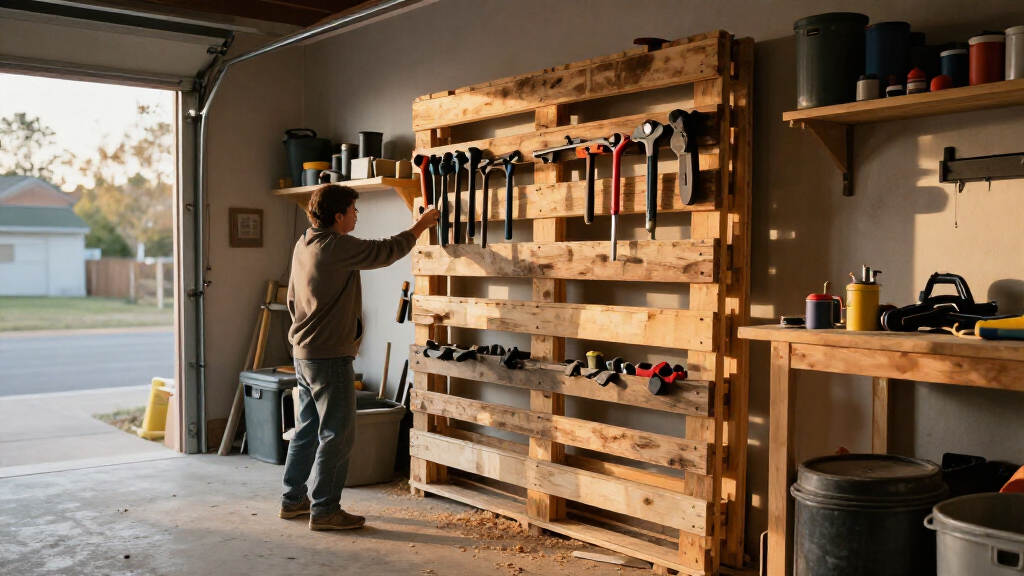
The approach keeps the pallet’s top deck partly intact rather than taking every board apart. Sections of those deck boards are then used to form the shelf surfaces. Builders can choose a shallower design using two boards across or make deeper shelves with four or five boards, depending on what they plan to store and the available garage space.
Because standard pallets are generally about 48 inches long, Hunker says they are not long enough to serve as the full frame for a floor-to-ceiling shelving unit. In the video’s design, the builder uses new lumber for the frame and shelf supports, then places the pallet-board sections on the supports. Hunker cites 8-foot, 2-by-3-inch dimensional lumber at about $3 at Home Depot as an example price; that figure is not a full materials estimate and may vary.
The reported build starts by cutting lumber for the intended shelf height and attaching the rear pieces to wall studs. The rest of the rectangular side frames and horizontal shelf supports are added afterward. Shelf spacing can be adjusted for different items, such as taller storage bins or shorter garage footwear storage. Hunker also recommends sanding the pallet boards before installation to smooth rough surfaces and reduce splinter risk. Paint, stain or plywood laid over the slats are presented as optional finishes.
Lower-Cost Materials, With Limits
The idea matters to homeowners seeking garage storage without buying a complete shelving system or purchasing all the shelf boards new. Reusing pallet wood can reduce the amount of new lumber needed, while new framing pieces address the limited length and possible irregularity of pallet boards. The arrangement also allows shelf depth and spacing to be tailored to the items being stored.
It is not a confirmed cost-saving guarantee. The source gives no complete bill of materials, labor estimate, comparison with retail shelving or load test. The final cost will depend on whether suitable pallets are available free or cheaply, the price of framing lumber, and the tools and hardware already on hand. Since the shelves are wall-mounted and intended to hold stored objects, secure attachment to studs and appropriate construction matter; the article does not specify fasteners or a safe weight capacity.
Products Worth Considering

Levoit Vital 100S-P Air Purifier with Washable Pre-Filter

Google Nest Learning Thermostat (4th Gen) with Nest Temperature Sensor (2nd Gen), Obsidian

Dyson Car+Boat Cordless Handheld Vacuum
As an affiliate, we earn on qualifying purchases.
How the Pallet Design Works
Hunker frames pallet wood as a low-cost alternative to buying all the lumber for garage shelves, noting that large DIY units can require a substantial amount of wood. Its cited example explains why the pallet is used for the shelf surfaces rather than as the entire structure: a typical pallet is around 48 inches long, while a tall shelving frame needs longer, straight supports.
The design is based on a video by NatürlichErtragreich, as described by Hunker. It combines reused boards with new framing lumber instead of treating the pallet as a ready-made shelving unit. Hunker advises readers new to pallet projects to learn how to source and dismantle pallets safely. The report also notes that pallet boards may have a rougher appearance than store-bought planks, a trade-off it presents as acceptable for functional garage storage.
“A cheaper wood source? The humble pallet.”
— Hunker, describing the project
Load Ratings and Costs Not Given
Hunker does not give a weight rating, tested capacity, exact dimensions for the finished unit or a complete shopping list. It also does not identify the fasteners used to attach the frame to studs or explain whether the design was tested with particular garage loads. Readers should not assume the shelves can safely hold heavy equipment based only on the description.
The report does not specify how to identify suitable pallets, confirm their prior use or treat them beyond sanding. Nor does it provide a final price: the cited lumber price is a single example, not a total project budget. The video’s date and whether its plans include further safety or installation details are not stated in the supplied source.
Check Materials Before Building
Anyone considering the project would need to inspect and source appropriate pallets, plan shelf dimensions and spacing, and determine the lumber and hardware required for the garage wall. Before loading the finished shelves, the frame should be secured to wall studs with suitable fixings and checked for stability. Hunker’s report points readers toward safe pallet sourcing and dismantling practices, but it does not provide a load test or engineering guidance.
The next useful details for readers would be a complete materials list, installation specifications and tested capacity from the video’s creator. Until those are available, the reported design is best understood as a customizable DIY concept rather than a verified shelving system with a stated safe load.
Key Questions
What part of the shelving is made from pallet wood?
The reported design uses sections of pallet deck boards for the slatted shelf surfaces. New lumber is used for the frame and shelf supports.
How deep can the shelves be?
Hunker describes using about two boards for a shallower shelf or four to five for a deeper one. The report does not give exact finished dimensions.
Does the source give a total cost or weight limit?
No. It cites an example price for 8-foot, 2-by-3-inch lumber, but gives no full project budget or tested shelf capacity.
Why does the design use new lumber?
Hunker says standard pallets are usually about 48 inches long, making them too short for the full-height frame described. New lumber provides longer framing and support pieces.
Source: hunker.com