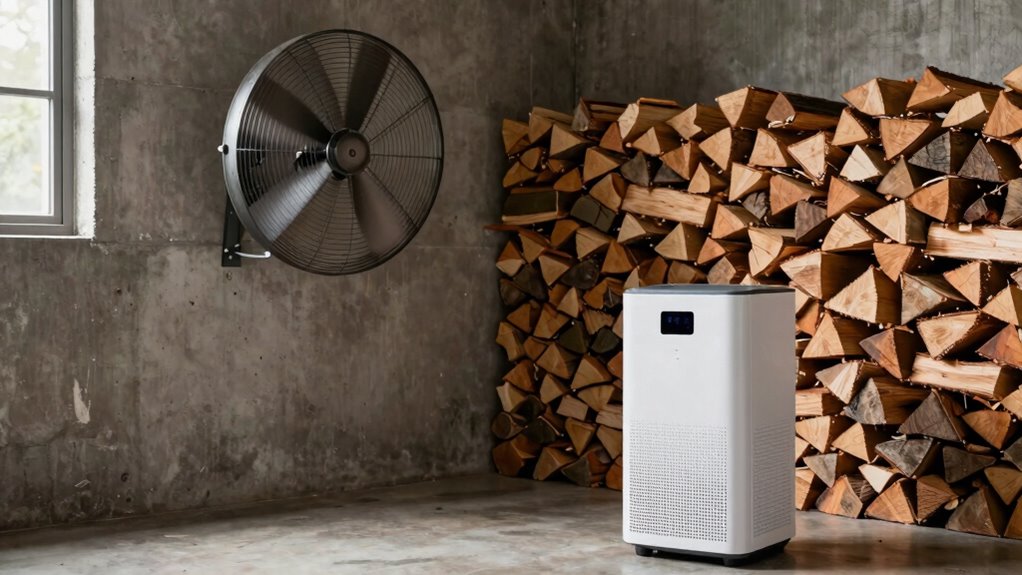
If you’re choosing between industrial fans and dehumidifiers for your firewood room, consider your climate and moisture issues. Fans circulate air to prevent mold and rot but don’t remove moisture directly, making them cost-effective and suitable for moderate humidity. Dehumidifiers actively reduce humidity levels, ideal for persistently damp spaces, but use more energy. Combining both offers the best moisture control. Keep exploring to find the best solution for your needs.
Key Takeaways
- Fans promote airflow and evaporation, preventing moisture buildup, but do not actively remove water vapor.
- Dehumidifiers directly extract moisture, maintaining consistent low humidity levels in high-moisture environments.
- Fans are energy-efficient and suitable for large spaces with moderate humidity issues.
- Dehumidifiers are more effective for persistent high humidity but consume more energy and higher operational costs.
- Combining fans and dehumidifiers offers optimal moisture control and airflow management for firewood storage.
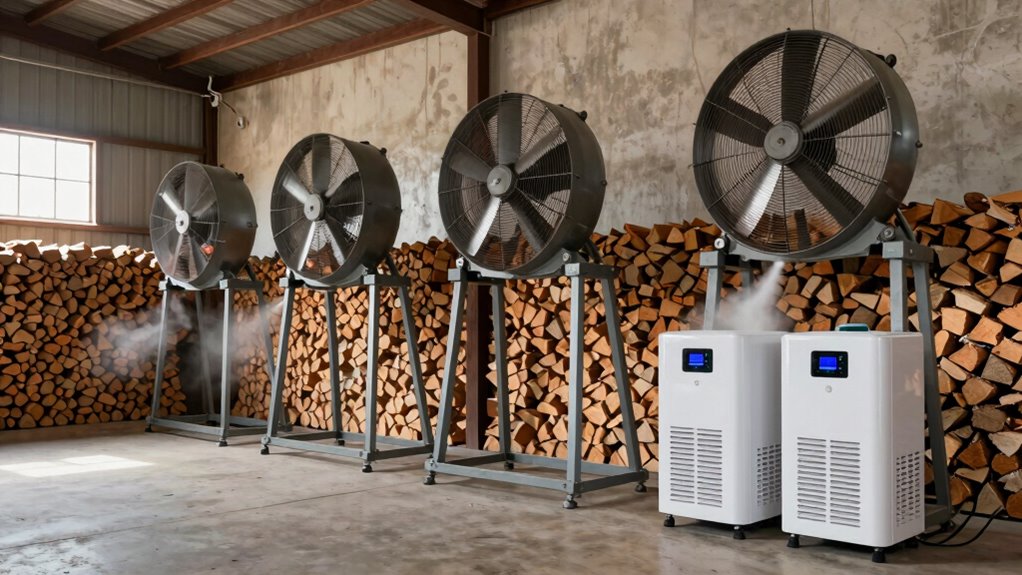
When it comes to maintaining the perfect environment for your firewood storage, choosing the right equipment is essential. Two common options are industrial fans and dehumidifiers, each offering unique advantages for moisture control and energy consumption. Your goal is to keep your firewood dry and ready for use, and the right equipment can make a significant difference in achieving that.
Industrial fans work by circulating air throughout your firewood room, promoting airflow and preventing moisture buildup. They’re effective at reducing stagnant, humid air pockets that can cause mold or rot. Because they move large volumes of air, fans are energy-efficient in terms of the amount of electricity used relative to the area they cover. They don’t remove moisture directly but help prevent excessive humidity levels by promoting evaporation and ventilation. If your primary concern is controlling moisture indirectly through airflow, industrial fans are a practical choice. They’re also relatively low-cost to operate and maintain, making them suitable for larger storage spaces. Incorporating air circulation strategies can enhance the effectiveness of your moisture control efforts. Proper airflow management can help prevent the buildup of stale, humid air that contributes to deterioration. Additionally, choosing the right type of fan, such as axial or centrifugal, can optimize performance based on your specific needs.
Industrial fans circulate air to prevent moisture buildup and mold in firewood storage.
Dehumidifiers, on the other hand, actively remove moisture from the air, providing precise control over humidity levels. They extract water vapor, which directly influences moisture control and helps keep firewood dry. This targeted approach can be more effective in environments where humidity levels are consistently high or when dealing with specific moisture problems. However, dehumidifiers tend to consume more energy compared to industrial fans, especially in larger spaces or highly humid conditions. The energy consumption can add up over time, which is an important factor to consider if you’re trying to keep operational costs low. Despite this, dehumidifiers offer the advantage of maintaining stable, optimal humidity levels, reducing the risk of mold, decay, and insect infestation—issues that can compromise your firewood quality. When selecting a dehumidifier, consider its capacity and efficiency to ensure it meets your storage needs without excessive energy use.
In choosing between the two, consider your firewood room’s size, humidity issues, and your budget for energy costs. If your space is large and humidity isn’t excessively high, industrial fans might suffice, providing good moisture control with lower energy use. But if you face persistent high humidity, investing in a dehumidifier could be more effective, despite the higher energy consumption. Some storage setups combine both solutions—using fans for circulation and dehumidifiers for moisture removal—to optimize conditions. Ultimately, your decision should focus on creating a stable, dry environment that preserves your firewood’s quality while balancing energy efficiency and operational costs. Proper ventilation is crucial in maintaining a healthy storage environment and preventing long-term moisture problems.

30" High Velocity Floor Fan, 14000CFM Heavy Duty Industrial Drum Fan with 3 Speeds, 550W, 360° Tilt with 2 Casters, Handle, Outdoor Metal Shop Fan for Garage, Factory, Patio, Basement, Commercial
- High-Performance Airflow: Up to 14,000 CFM at high speed
- Three Speed Settings: High, Medium, Low for versatile cooling
- Heavy-Duty Metal Construction: Durable, corrosion-resistant all-metal build
As an affiliate, we earn on qualifying purchases.
As an affiliate, we earn on qualifying purchases.
Frequently Asked Questions
Which Option Is More Energy-Efficient for Long-Term Use?
Dehumidifiers are more energy-efficient for long-term use because they consume less energy compared to industrial fans, making them more cost-effective over time. They maintain ideal humidity levels with minimal energy consumption, helping you save on utility bills. Industrial fans use more power to circulate air constantly, which can increase energy costs. So, if you’re prioritizing cost effectiveness and lower energy consumption, a dehumidifier is the better choice for long-term use.
How Do Noise Levels Compare Between Fans and Dehumidifiers?
Ever wondered which device is quieter? Generally, dehumidifiers produce less noise than industrial fans, thanks to better sound insulation and noise mitigation features. Fans tend to generate more constant, higher-decibel sounds, especially at high speeds. If you prioritize a peaceful environment, dehumidifiers are the quieter choice. Think about where you’ll place them; strategic positioning can further reduce noise impact, making your firewood room more comfortable.
Can Both Devices Be Used Simultaneously for Better Results?
Yes, using both devices together can create dual device synergy, improving firewood room conditions. To maximize benefits, you should focus on ideal placement—fans should circulate air efficiently, while dehumidifiers target moisture. This combined approach helps enhance airflow and moisture control, keeping your firewood dry and ready. Just make sure the devices don’t interfere with each other’s operation, and monitor their settings for the best results.
What Maintenance Is Required for Each Device Type?
You need to regularly maintain both devices for peak performance. For industrial fans, check and replace filters as needed and guarantee blades are clean to prevent dust buildup. For dehumidifiers, filter replacement is essential to maintain efficiency, and you should monitor power consumption to identify any issues. Both devices benefit from routine inspections, cleaning, and timely filter replacements, helping them operate efficiently and prolonging their lifespan.
Are There Specific Safety Concerns for Firewood Storage?
Imagine a firewood storage area where improper ventilation leads to moisture buildup, increasing fire risk and pest problems. Safety concerns include keeping fire hazards away from heat sources and ensuring proper pest prevention. You should regularly check for mold, pests, and excess moisture, and keep the area well-ventilated. Using industrial fans or dehumidifiers carefully can help mitigate these risks, but always follow safety guidelines to prevent accidents.
Conclusion
Choosing between industrial fans and dehumidifiers depends on your firewood room’s specific needs. Think of fans as the breeze that keeps things moving, preventing moisture buildup through air circulation. Dehumidifiers, on the other hand, are like a sponge soaking up excess moisture. Ideally, using both creates a symphony of dry, well-ventilated space—like a well-tuned orchestra—ensuring your firewood stays dry and ready for use, no matter the weather outside.