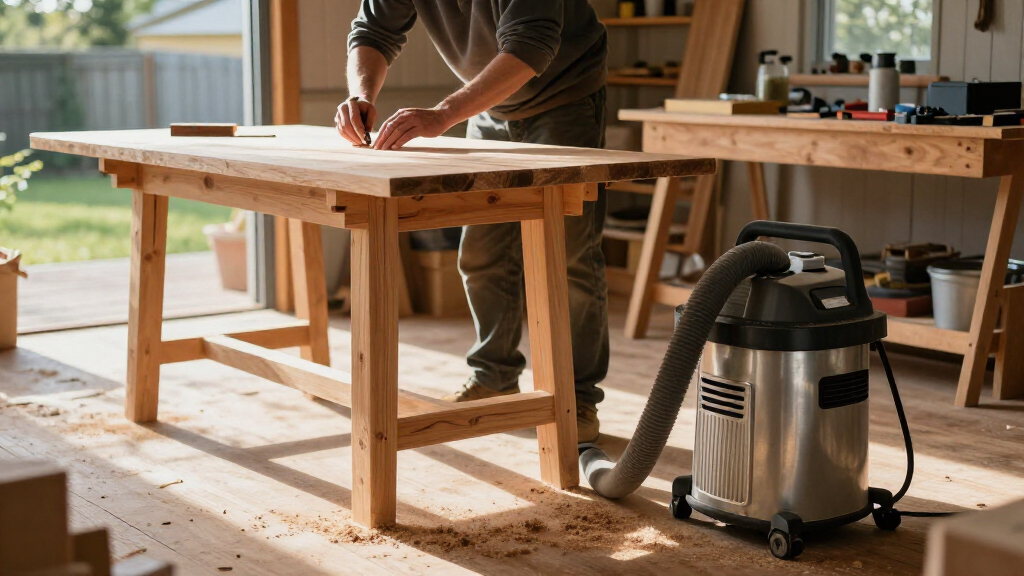
The best woodworking dust collectors balance airflow, filtration, and shop space; my best overall pick is the WEN DC1300, with its 1,300 CFM capacity and mobile base suited to larger workshops. For a smaller shop, the POWERTEC DC5371 offers a wall-mounted 560 CFM setup, while the VEVOR 1.5 HP Vortex Cone is a stronger step-up choice for buyers who want higher airflow in a compact footprint. The main tradeoffs are how many machines you need to serve, how fine a particle filter you need, and whether you can spare floor space for a larger collector. Portable and tabletop units save room, but they suit more limited collection needs than a central shop machine. Read on for the full breakdown and guidance on matching a collector to your tools.

Get business pricing on tools and workshop supplies
- Business-only prices and quantity discounts
- Tax-exempt purchasing
- Multiple users, one account, clear invoices
Complete the kit


Key Takeaways
- The WEN DC1300 stands out for larger shops because its listed 1,300 CFM capacity exceeds the 560 CFM wall-mount and portable options in this roundup.
- Wall-mounted models such as the POWERTEC DC5371 and VEVOR 1 HP unit preserve floor space, but their 560 CFM class makes them better suited to targeted collection than serving many machines at once.
- The VEVOR 1.5 HP Vortex Cone offers a middle ground between smaller collectors and the DC1300, pairing 1,100 CFM with a cone-style design and 2.5-micron filtration.
- Tabletop collectors from Abestorm and PSI address focused bench-level dust, not the same whole-machine collection job as the larger bag and cyclone units.
- A listed airflow figure alone does not settle the choice: filter rating, duct layout, machine connection, portability, and available space all affect whether a collector fits a particular shop.


| woodworking dust collector | Airflow | Motor | Weight |
|---|---|---|---|
| WEN DC1300 1,300 CFM Woodworki | Up to 1,300 CFM | 14 amp | — |
| POWERTEC 1 HP Wall-Mount Dust | — | 1 HP induction motor | — |
| VEVOR 1 HP Wall-Mount Dust Col | 560 CFM | — | — |
| POWERTEC DC5372 1 HP Portable | — | 1 HP induction motor | 43.6 pounds |
| WEN 15-Gallon Woodworking Dust | Up to 600 CFM | 7.4-amp induction motor | 41.1 pounds |
| Abestorm Tabletop Dust Collect | — | — | 19.96 pounds |
| PSI Woodworking DC725 Portable | — | — | — |
| VEVOR 1.5 HP Vortex Cone Dust | 1100 CFM | 1.5 HP induction motor | — |
| POWERTEC DC1081 1 HP Dust Coll | 800 CFM | — | 55 pounds |
| WEN DC3401 12-Gallon Woodworki | Up to 660 CFM | 5.7-amp brushed | 17 pounds |
| VEVOR Cyclone Dust Collector | 763 CFM | — | 114.9 lb |
More Details on Our Top Picks
WEN DC1300 1,300 CFM Woodworking Dust Collector with 50-Gallon Bag and Mobile Base
The WEN DC1300 is the lineup’s high-capacity choice: its stated 1,300 CFM airflow and two 4-inch inlets let it serve larger machines or connect to two tools, while the 50-gallon bag means less frequent emptying than the smaller WEN DC3474’s 15-gallon bag. Its steel impeller and wheeled base suit a shop where the collector may need to move between stations. The tradeoff is footprint and flexibility: unlike the wall-mount POWERTEC DC5371, this is a floor unit, and its single speed offers no lower setting for lighter tasks. It is also intended for indoor use, and the listed 5-micron filtration is not a substitute for fine-dust control at the breathing zone. I’d choose it for chip and sawdust collection across a fuller shop, not as a compact sanding-dust solution.
Pros:- Stated airflow of up to 1,300 CFM suits higher-demand collection tasks.
- Two 4-inch inlets allow connection to up to two tools.
- 50-gallon bag reduces how often collection needs to be emptied.
- Four swivel casters make it easier to reposition around a shop.
Cons:- Single-speed operation limits adjustment for different tools and tasks.
- Floor-based design takes more shop space than wall-mount options such as the POWERTEC DC5371.
- 5-micron filtration is less suited to capturing the finest airborne dust.
Best for: Woodworkers with multiple 4-inch-port machines who want high stated airflow and a large bag in a mobile floor unit.
Not ideal for: Small shops short on floor space, or woodworkers seeking variable-speed control or fine-dust filtration for sanding.
- Airflow:Up to 1,300 CFM
- Motor:14 amp
- Filter:5 micron
- Collection bag capacity:50 gallons
- Inlets:Two 4-inch inlets
- Impeller:10-inch steel
- Impeller speed:Up to 3,450 RPM
- Mobility:Mobile base with four swivel casters
- Warranty:Two years
Our verdict“Choose the DC1300 if your shop needs high stated airflow, two tool connections, and a large collection bag more than compact storage or variable speed.”
POWERTEC 1 HP Wall-Mount Dust Collector, 560 CFM, with 1-Micron Filter Bag (DC5371)
The POWERTEC DC5371 earns its place for shops where preserving floor space matters more than moving a collector between machines. Its wall, workbench, or floor mounting gives more setup choices than the wheeled POWERTEC DC5372, while the reusable 1-micron bag has a viewing window and bottom zipper for checking and clearing the contents. The 560 CFM rating and single 4-inch inlet make it a match for one compatible machine at a time, rather than a substitute for the WEN DC1300’s higher stated airflow and dual inlets. POWERTEC lists a Vortex Base to guide airflow, but filtration claims are not accompanied by independent testing in the provided data. The inlet grate also needs clog checks, and the listed 80 dB operating level may be noticeable in a small shop. I’d pick it when mounting flexibility is the deciding factor.
Pros:- Wall, workbench, and floor mounting options suit different shop layouts.
- Reusable 1-micron cloth bag includes a viewing window and bottom zipper.
- 560 CFM rating supports collection from a compatible 4-inch-port machine.
- Dual-voltage motor supports 120V or 240V operation.
Cons:- Single 4-inch inlet is less versatile than the WEN DC1300’s two inlets.
- Inlet grate can collect debris and needs regular clog checks.
- The listed 1-micron filtration has no independent testing details in the provided product data.
Best for: Small-shop woodworkers who want a 4-inch-port collector that can be wall-mounted to reclaim floor space.
Not ideal for: Operators who need to move a collector between several stations often, or connect multiple tools at once.
- Motor:1 HP induction motor
- Voltage:120V/240V
- Current:12A at 120V; 6A at 240V
- Airflow capacity:560 CFM
- Inlet size:4 inches
- Filter:Reusable 1-micron cloth bag
- Height:44 inches with bag inflated
- Noise level:80 dB
- Mounting options:Wall, workbench, or floor
Our verdict“Choose the DC5371 when wall-mount flexibility and a reusable filter bag matter more than portability or multi-tool capacity.”
VEVOR 1 HP Wall-Mount Dust Collector, 560 CFM
The VEVOR 1 HP Wall-Mount Dust Collector pairs a 560 CFM rating with a 21-gallon collection bag, giving it more stated storage capacity than the POWERTEC DC5371’s listed setup while keeping the collector off the floor. Its 2.5-micron non-woven bag and bottom zipper target routine sawdust and sanding-dust cleanup, with a straightforward emptying method. Compared with the POWERTEC, though, the filtration rating is coarser than its listed 1-micron bag, and VEVOR specifies noise of up to 90 dB rather than the POWERTEC’s 80 dB. The product data positions it for small and medium projects, so I wouldn’t treat its airflow figure as proof that it can serve a large ducted system or several machines simultaneously. This is a practical choice for a fixed station where bag capacity matters more than quieter operation or finer stated filtration.
Pros:- 560 CFM airflow rating suits collection at a compatible woodworking station.
- 21-gallon bag offers more capacity than the POWERTEC DC5371’s described setup.
- 2.5-micron filtration is specified for the non-woven bag.
- Bottom zipper simplifies bag emptying.
Cons:- Operating noise is rated at up to 90 dB.
- Its 2.5-micron filtration rating is coarser than the POWERTEC DC5371’s listed 1-micron bag.
- Product data limits its intended fit to small and medium woodworking projects.
Best for: Woodworkers with a fixed small- or medium-project station who want a wall-mounted collector with a larger bag.
Not ideal for: Users prioritizing lower noise, finer stated filtration, or dust collection across a large shop and multiple machines.
- Mounting:Wall mount
- Motor power:1 HP
- Airflow:560 CFM
- Collection bag capacity:21 gallons (80 L)
- Filtration:2.5 microns
- Operating noise:Up to 90 dB
- Bag material:Non-woven
- Bag feature:Bottom zipper for emptying
Our verdict“Pick this VEVOR for a fixed, modest-size shop station where bag capacity takes priority over quieter running or finer stated filtration.”
POWERTEC DC5372 1 HP Portable Dust Collector, 560 CFM, with 1-Micron Filter Bag
Where the POWERTEC DC5371 is built around mounting choice, the POWERTEC DC5372 is the more mobile sibling: its casters and 43.6-pound weight make it easier to move between compatible machines. Both list 560 CFM, a 1 HP induction motor, and a reusable 1-micron bag with a viewing window and bottom zipper, so the key choice is placement rather than airflow. The DC5372’s 4-inch inlet keeps it suited to one machine connection at a time; it does not match the WEN DC1300’s dual inlets or higher airflow rating. POWERTEC’s Vortex Base is designed to guide airflow, but the protected inlet can collect debris and needs routine checking. I’d favor this model for a shop that changes workstations often and values portability, while a fixed layout may make the wall-mount DC5371 the tidier fit.
Pros:- Casters make it easier to reposition between machines.
- Reusable 1-micron cloth bag has a viewing window and bottom zipper.
- Dual-voltage motor supports 120V or 240V operation.
- 4-inch inlet fits compatible woodworking machine ports.
Cons:- Single 4-inch inlet does not support the dual-tool setup offered by the WEN DC1300.
- Protected inlet port can collect debris and needs regular clog checks.
- At 43.6 pounds, moving it still takes more effort than shifting a lightweight accessory.
Best for: Woodworkers who move a 4-inch-port collector between machines and want a reusable filter bag with an easy-empty zipper.
Not ideal for: Shops that need a fixed wall-mounted setup, multiple simultaneous tool connections, or higher airflow than 560 CFM.
- Motor:1 HP induction motor
- Voltage:120V/240V
- Current:12 amps at 120V; 6 amps at 240V
- Motor speed:3,450 RPM
- Airflow capacity:560 CFM
- Inlet size:4 inches
- Filter:Reusable 1-micron cloth bag
- Weight:43.6 pounds
Our verdict“Choose the DC5372 if you want a wheeled, 560 CFM collector with a reusable 1-micron bag for moving between compatible machines.”
WEN 15-Gallon Woodworking Dust Collector, 7.4-Amp Motor, Mobile Base and Optional Wall Mount (DC3474)
The WEN DC3474 offers a useful middle ground for shops that want either a mobile collector or a wall-mounted installation. Its built-in mounting option distinguishes it from the floor-focused WEN DC1300, while its up to 600 CFM rating exceeds the 560 CFM listed for the POWERTEC DC5371 and DC5372. The tradeoff is capacity: its 15-gallon, 5-micron bag is much smaller than the DC1300’s 50-gallon bag, and the single 4-inch port means one compatible tool connection at a time. At 41.1 pounds, the casters and carrying handle help with repositioning, though it is not a lightweight unit to lift. I’d choose it for a compact shop layout that may change, or for a dedicated wall installation, rather than a larger shop needing greater bag capacity or multiple inlets.
Pros:- Can be used on four swivel casters or installed with its built-in wall-mount option.
- Up to 600 CFM exceeds the listed 560 CFM of the POWERTEC DC5371 and DC5372.
- 15-gallon zippered bag provides a contained collection setup.
- Two-year warranty is specified.
Cons:- 15-gallon capacity requires more frequent emptying than the WEN DC1300’s 50-gallon bag.
- Single 4-inch dust port limits it to one tool connection at a time.
- At 41.1 pounds, it may be awkward to lift for mounting or frequent carrying.
Best for: Owners of small or changing shop layouts who want a 4-inch collector that can roll between stations or mount on a wall.
Not ideal for: Woodworkers needing a large collection bag, multiple tool inlets, or finer filtration than the listed 5-micron bag.
- Motor:7.4-amp induction motor
- Impeller:9 inches
- Airflow:Up to 600 CFM
- Dust port:4 inches
- Collection bag:15 gallons, 5-micron zippered
- Dimensions:43.3 x 17.7 x 20.1 inches
- Weight:41.1 pounds
- Mobility:Four 2-inch swivel casters and onboard carrying handle
- Warranty:Two years
Our verdict“Choose the DC3474 if you want a mid-capacity collector with both rolling and wall-mount options, and can work within its single-port, 15-gallon setup.”
Abestorm Tabletop Dust Collector with Timer for Woodworking Shops
The Abestorm is better suited to capturing airborne dust near a bench than moving chips through a shop-wide hose system. Its two settings, rated at 580 and 780 CFM, plus a MERV-13 filter and timer make it a more air-cleaning-focused choice than the WEN DC3401, which connects to a 4-inch dust hose for tool pickup. The 120-minute timer can keep the unit running after a sanding or carving session without requiring someone to switch it off manually.
Its metal housing, handle, and cord wrap support repositioning, though at nearly 20 pounds it is portable rather than featherweight. I would skip it as a primary collector for a table saw or other chip-producing machine: it lacks a listed hose port, and the 11.5-foot cord may limit placement. The timer also needs AA batteries, and its maximum run time is finite.
Pros:- Two airflow settings, rated at 580 and 780 CFM, let users adjust operation to the task.
- MERV-13 filter is specified to last up to six months.
- Programmable timer runs for up to 120 minutes.
- Metal housing, carrying handle, and cord wrap aid storage and repositioning.
Cons:- At 19.96 pounds, moving it between work areas may be inconvenient.
- Timer requires two AA batteries and is limited to 120 minutes.
- The listed 11.5-foot power cord can restrict placement in larger shops.
Best for: Woodworkers who sand, carve, or finish at a bench and want filtered air capture with timed operation.
Not ideal for: Shops seeking a central or hose-connected collector for machines that produce heavy chips; this model is designed around tabletop air cleaning.
- Airflow settings:580 CFM and 780 CFM
- Filter:MERV-13; stated life up to six months
- Dimensions:14.57 x 9.45 x 11.81 inches
- Weight:19.96 pounds
- Electrical requirements:115 V, 0.9 A, 100 W
- Timer:Programmable up to 120 minutes; requires 2 AA batteries
- Construction:Metal housing
- Additional features:Auxiliary outlet and circuit-breaker protection
Our verdict“Choose the Abestorm for timed, filtered dust capture around a workbench, not as the main hose-connected collector for machinery.”
PSI Woodworking DC725 Portable Tabletop Dust Collector
The PSI DC725 is aimed at small, close-up projects such as carving, woodburning, sanding, and tabletop turning. Three computer-grade fans draw dust through the included filter, while adjustable clear doors let the user direct airflow toward the work. That makes it more task-focused than the Abestorm, whose timer and MERV-13 filter favor unattended air cleaning; the PSI instead adds variable speed control and two grounded outlets for a tool or work light.
Its quiet, maintenance-free fans suit a bench where a large collector would be intrusive, but 725 CFM does not make it a substitute for a hose-connected machine collector. The 23-inch width also takes up meaningful bench space, and the supplied product information conflicts on weight and cabinet dimensions. I would choose it for detailed work, not routine chip collection from larger machines.
Pros:- Three quiet, maintenance-free fans draw dust through the included filter.
- Adjustable airflow doors can direct capture toward a small work area.
- Variable speed control supports adjustment for different bench tasks.
- Two grounded outlets can power a tool or work light.
Cons:- Designed for tabletop projects rather than larger machine dust collection.
- At 23 inches wide, it uses substantial bench space.
- Product information gives conflicting weight and cabinet dimensions.
Best for: Carvers, woodburners, and hobby woodturners who need adjustable dust capture at a dedicated tabletop station.
Not ideal for: Woodworkers needing a compact unit or a collector connected to larger shop machines; its cabinet occupies bench space and its intended use is small-scale.
- Maximum airflow:725 CFM
- Fans:Three computer-grade fans
- Motor voltage:110 V
- Running current:1.29 A
- Dimensions:23 x 8 x 10.5 inches
- Filter size:2 x 10 x 20 inches
- Outlets:Two grounded 115 V outlets
- Warranty:Two years under normal use
Our verdict“Pick the PSI DC725 for adjustable, quieter capture at a small-project bench, but not for collecting chips from full-size machines.”
VEVOR 1.5 HP Vortex Cone Dust Collector, 1100 CFM, 2.5-Micron Filtration
Among these five picks, the VEVOR is the clearest step toward a larger, stationary shop collector. Its 1.5 HP induction motor and stated 1100 CFM airflow give it more capacity for sawdust and chips than the POWERTEC DC1081 at 800 CFM or the WEN DC3401 at up to 660 CFM. A 42-gallon collection bag also means fewer interruptions to empty it during sustained work, and clip-style access is intended to simplify bag removal.
The tradeoff is its substantial footprint: at more than six feet tall and 68.1 pounds, it needs dedicated floor space rather than a convenient spot beside a bench. Its 2.5-micron filtration is less fine than the POWERTEC’s listed 1-micron filter, and the stated noise level under 90 dB may still be loud in a small shop. I would reserve this pick for buyers who value capacity over compactness.
Pros:- Stated 1100 CFM airflow offers more capacity than the POWERTEC DC1081 and WEN DC3401.
- 42-gallon collection bag supports longer runs between emptying.
- Clip-style bag access is designed to make emptying easier.
- Induction motor is rated at 1.5 HP.
Cons:- Large 36.22 x 29.13 x 75.59-inch footprint requires dedicated floor space.
- 2.5-micron filtration is less fine than the POWERTEC DC1081’s listed 1-micron filter.
- Noise is specified as under 90 dB, which may be disruptive in a small workspace.
Best for: Woodworkers with floor space who run chip-producing machines and want higher stated airflow and a large collection bag.
Not ideal for: Small-shop users prioritizing a compact footprint or finer listed filtration; this unit is tall, heavy, and rated to 2.5 microns.
- Airflow:1100 CFM
- Motor:1.5 HP induction motor
- Filtration:2.5 microns
- Collection bag:42 gallons (159 L)
- Noise level:Under 90 dB
- Speed:3400 RPM
- Voltage:120 V
- Dimensions and weight:36.22 x 29.13 x 75.59 inches; 68.1 pounds
Our verdict“Choose the VEVOR when airflow and bag capacity matter more than compact size or finer listed filtration.”
POWERTEC DC1081 1 HP Dust Collector with 1-Micron Filtration and Mobile Base
The POWERTEC DC1081 balances a hose-connected 800 CFM setup with a listed 1-micron filter bag, making it a sensible middle ground for a small shop that wants more than a bench air cleaner. Compared with the WEN DC3401, it offers higher stated airflow and finer listed filtration, while its four-caster base and quick-release clamps make moving the collector and removing its bag less of a chore. The 4-inch intake also gives it a clear role as a machine-connected collector.
It does not match the VEVOR 1.5 HP model’s 1100 CFM airflow or 42-gallon bag, so buyers running several demanding machines should look higher in capacity. Assembly is required, and the listing specifies indoor use only. I would favor this POWERTEC for a mobile, single-machine setup where filtration and manageable shop-floor mobility count more than large-bag endurance.
Pros:- 800 CFM airflow is higher than the WEN DC3401’s stated maximum of 660 CFM.
- Listed 1-micron filter bag captures finer particles than the VEVOR model’s 2.5-micron filtration.
- Four casters make it easier to reposition around the shop.
- Quick-release clamps simplify collection-bag removal.
Cons:- Lower stated airflow than the VEVOR 1.5 HP model’s 1100 CFM.
- Assembly is required.
- Specified for indoor use only.
Best for: Small-shop woodworkers connecting one machine at a time who want a mobile collector with a listed 1-micron filter bag.
Not ideal for: Shops needing high-volume extraction for multiple demanding machines or a collector for outdoor use; its airflow is 800 CFM and it is specified for indoor use.
- Motor power:1 HP
- Airflow:800 CFM
- Filtration:1 micron
- Intake port:4 inches
- Motor speed:3450 RPM
- Voltage:120/240 V
- Mobility:Four wheels
- Weight:55 pounds
Our verdict“Choose the POWERTEC DC1081 for a mobile, hose-connected setup where its 1-micron bag matters more than maximum airflow or collection capacity.”
WEN DC3401 12-Gallon Woodworking Dust Collector
The WEN DC3401 is the most compact floor-style option in this group, weighing 17 pounds and measuring 34.25 inches long. Its 4-inch dust port and up-to-660-CFM airflow make it a more direct fit for a machine hose than the Abestorm tabletop collector, while its lockable swivel casters and carrying handle help when one collector needs to serve several stations. The optional wall mount is useful in a crowded shop where floor space is at a premium.
Compared with the POWERTEC DC1081, the WEN trades some airflow—660 CFM maximum versus 800 CFM—for a lighter, smaller package. Its 12-gallon, 5-micron bag also means less capacity and coarser listed filtration than the POWERTEC’s 1-micron bag. A single speed limits adjustment, so I would choose it for occasional or lighter-duty collection, not a high-demand multi-machine setup.
Pros:- 17-pound weight, carrying handle, and lockable casters support easy repositioning.
- Optional wall mount can free up floor space.
- Up to 660 CFM airflow and a 4-inch port suit a compact machine-connected setup.
- Two-year warranty.
Cons:- Single-speed operation offers no airflow adjustment.
- The 12-gallon bag has less capacity than the VEVOR model’s 42-gallon bag.
- Listed 5-micron filtration is coarser than the POWERTEC DC1081’s 1-micron filter.
Best for: Hobby woodworkers with limited shop space who need a light, movable collector for a 4-inch machine hose.
Not ideal for: Users seeking multi-speed control, finer listed filtration, or high-capacity collection; it has one speed and a 12-gallon, 5-micron bag.
- Motor:5.7-amp brushed
- Impeller:6 inches
- Airflow:Up to 660 CFM
- Dust port:4 inches
- Collection bag:12 gallons; 5-micron zippered bag
- Dimensions:34.25 x 13 x 14.2 inches
- Weight:17 pounds
- Mobility and mounting:Four lockable swivel casters; optional wall mount
- Warranty:Two years
Our verdict“Pick the WEN DC3401 for a lightweight, space-conscious shop setup, but choose the POWERTEC DC1081 for finer filtration and higher stated airflow.”
VEVOR Cyclone Dust Collector, 763 CFM, 1.5 HP, 1-Micron Filtration
The VEVOR Cyclone pairs 763 CFM airflow with 1-micron filtration, making it a middle-ground choice for shops that want finer filtration than the VEVOR 1.5 HP Vortex Cone’s 2.5-micron rating without stepping up to that model’s stated 1,100 CFM. Its 12.5-gallon drum offers more room between cleanouts than compact tabletop collectors, while the window and lever-release bin make it easier to check and empty. The tradeoff is capacity: the WEN DC1300’s 50-gallon bag suits longer collection runs, and this model’s 763 CFM is below both that collector’s 1,300 CFM and the VEVOR Vortex Cone’s 1,100 CFM. At 114.9 pounds and up to 90 dB, it also calls for dedicated floor space and may be loud for a shared shop.
Pros:- 1-micron filtration targets finer dust than the VEVOR Vortex Cone’s stated 2.5-micron filtration.
- 763 CFM airflow offers more capacity than the 560 CFM wall-mount and portable collectors in the lineup.
- 12.5-gallon drum provides substantial collection capacity for a mid-range shop setup.
- Rolling wheels, a dust-level window, and lever-release bin aid movement and cleanup.
Cons:- Airflow is lower than the WEN DC1300’s 1,300 CFM and the VEVOR Vortex Cone’s 1,100 CFM.
- The 12.5-gallon drum fills sooner than the WEN DC1300’s 50-gallon bag.
- Listed noise reaches 90 dB, and its 114.9-pound weight makes it a substantial piece of shop equipment.
Best for: Woodworkers who want 1-micron filtration and a cyclone-style drum for a stationary shop, but do not need the higher airflow or larger collection capacity of the WEN DC1300.
Not ideal for: Small or noise-sensitive shops, and buyers who need maximum airflow or extended collection capacity; its 114.9-pound footprint, listed noise level, and 12.5-gallon drum may be limiting.
- Airflow:763 CFM
- Motor power:1.5 HP induction motor
- Filtration:1.0 micron
- Drum capacity:12.5 gallons (47 L)
- Voltage:120 V
- Noise level:≤ 90 dB
- Weight:114.9 lb
- Dimensions:41.34 x 19.69 x 61.42 in
- Model:DC20002
Our verdict“Choose this VEVOR for a floor-standing collector that prioritizes 1-micron filtration and manageable drum cleanup over the higher airflow and capacity of the WEN DC1300.”

How We Picked
I compared these woodworking dust collectors by the jobs their designs appear suited to: larger-shop collection, single-machine use, space-saving wall mounting, portable setups, and focused tabletop cleanup. I weighed listed airflow alongside filtration details, capacity or collection style, mobility, mounting options, and how much shop space each format asks for. A higher CFM figure can help support more demanding collection needs, but it does not guarantee performance through long or narrow duct runs.
The ranking favors useful balance for the widest range of woodworking shops, then separates the remaining models by clear buyer need. The WEN DC1300 leads for its higher listed airflow and mobile base; wall-mounted and portable 560 CFM models rank well for smaller shops, while tabletop products are placed for their narrower task. I also account for information provided in the product names: where filtration or airflow details are not listed, I avoid treating those specifications as confirmed. Buyers should verify compatibility, filter details, and installation requirements for their own tools and setup.
Factors to Consider When Choosing Woodworking Dust Collectors
Choosing among woodworking dust collectors starts with the work the machine must do, not the biggest number on the box. These factors help connect collector format and capacity to the layout, tools, and dust exposure in your shop.
Match Airflow to the Tool and Duct Layout
Start with the dust port requirements of the machines you plan to connect, then check how the collector will be joined to them. A single short hose to one tool places different demands on a system than long ducting with several branches. Bends, narrow hose, and restrictive fittings can reduce airflow, so a collector’s listed CFM should not be treated as the airflow every tool will receive. Avoid buying on CFM alone; check the manufacturer’s airflow guidance and the tool’s port size. If you plan to run multiple machines, confirm whether the system is designed for simultaneous use or requires closing unused branches. A modest collector with a direct connection can be a better fit than a larger unit poorly matched to the duct network.
Choose Filtration for the Dust You Need to Capture
Collection at the tool and fine-particle filtration are related but separate jobs. A machine can capture visible chips while allowing finer dust to pass through a basic filter, so check the filter’s stated particle rating and whether a finer cartridge or upgrade is available. Ratings are not directly comparable unless they use the same testing method, and the filter’s condition affects performance over time. Buyers who work with fine sanding dust should give filtration more weight than a woodworker mainly collecting larger chips. Also check whether replacement filters are available and how difficult they are to clean or change. A collector’s bag size or airflow rating cannot by itself tell you how much fine dust stays out of the shop air.
Decide Between Fixed, Mobile, and Tabletop Formats
Wall-mounted units free floor area and can keep a collector near a stationary machine, but the mounting location needs suitable support and a practical route for hose or duct. Mobile bases are useful when one collector serves several tools, although moving it repeatedly can become inconvenient if connections need frequent changes. Tabletop units have a different role: they can address dust around a bench task but are not a replacement for a machine-connected collector. Measure clearance around machines, doors, and storage before choosing a footprint. Think about where the hose will sit when the collector is not in use, since awkward routing can make a theoretically convenient setup less likely to be used. The right format depends on the workflow, not just the collector’s size.
Account for Capacity, Emptying, and Filter Maintenance
Collection capacity affects how often you stop work to empty a bag or container, while filter maintenance affects how consistently the system can move air. A larger bag can reduce interruptions during chip-heavy work, but it also takes more room and can be harder to handle when full. Compact collectors may be easier to place yet need more frequent attention. Check how the collection container attaches, whether it is accessible in the intended location, and what the maker specifies for cleaning the filter. Do not wait for a collector to feel weak before checking for a full bag, clogged filter, or blocked hose. A maintenance routine that fits your shop habits can matter more than a small difference in rated capacity.
Plan for Noise, Power, and Installation
Before buying, confirm the collector’s electrical requirements and whether your shop circuit can support it alongside other equipment. Installation may also involve wall framing, duct supports, adapters, or a suitable outlet, so the collector itself is only part of the setup. Noise can matter in a shared garage or small room, especially if the collector runs while you work; check manufacturer information and plan where the unit will sit. Longer duct routes may call for a different placement or system design than a nearby single tool. Make room for filter access and bag changes rather than squeezing the unit into a corner that is hard to service. A realistic installation plan can prevent a capable collector from becoming inconvenient to use.
Frequently Asked Questions
Is a 560 CFM collector enough for a woodworking shop?
It can suit a compact shop focused on one machine at a time, especially when the collector connects directly through a short, appropriately sized hose. The POWERTEC and VEVOR wall-mount options in this roundup are listed at 560 CFM, which makes them easier to place than larger floor units but less suited to broad multi-machine ducting. Actual airflow at the tool depends on hose size, bends, fittings, and filter condition. Check the tool maker’s collection guidance before choosing. If several tools or longer duct runs are part of the plan, compare higher-capacity systems and confirm their intended configuration.
Can a tabletop dust collector replace a machine-connected dust collector?
Usually not, because a tabletop collector and a machine-connected collector address different dust sources. The Abestorm and PSI tabletop models are intended for focused bench-level collection, while larger units connect to tools that produce chips and dust at a port. A tabletop unit may help with a specific task, but it should not be treated as a substitute for collection at a planer, saw, or other machine with a dust port. Consider the kind of debris, where it is produced, and whether the collector can capture it at the source. Many shops may need a dedicated machine collector even if they also use a bench unit.
Should I prioritize airflow or filtration when comparing dust collectors?
Neither specification should be judged alone: airflow helps move dust from the tool, while filtration determines what the collector captures or returns to the room. A high listed CFM does not compensate for a filter that does not match your fine-dust needs, and a fine filter cannot help much if the tool connection captures little dust. For chip-heavy work, collection performance and suitable airflow may be the first concern; for sanding or work that creates fine dust, filter details deserve greater attention. Check the filter rating and its stated test basis, as well as the collector’s airflow guidance. Your tools, duct layout, and dust exposure should set the balance.
When is a cyclone-style collector worth choosing over a bag collector?
A cyclone design may appeal when you want a larger shop system and prefer a collection arrangement that separates debris before it reaches the filter. The VEVOR 1.5 HP Vortex Cone and VEVOR Cyclone models represent cyclone-style options in this lineup, while the WEN DC1300 is a larger bag-based collector. The choice depends on the design’s capacity, filtration, footprint, and maintenance needs rather than the word cyclone alone. Compare how the container is emptied, how the filter is serviced, and whether the unit fits your duct plan. For a small shop collecting from one tool, a simpler bag unit may be easier to place and manage.
What should I check before mounting a wall-mounted dust collector?
Confirm that the wall structure can support the unit and its collected debris, and follow the manufacturer’s mounting instructions rather than fastening it to an unsupported surface. Check that the location leaves enough room to remove or empty the collection bag and service the filter. Plan the hose or duct route so it does not obstruct walkways or introduce avoidable bends and restrictions. Verify outlet access and the unit’s electrical requirements before installation. Also think about noise and whether the placement keeps the collector close enough to the intended machine to make a practical connection.
Conclusion
For a broad mix of machines and a larger workspace, I recommend the WEN DC1300 as the best overall because its listed 1,300 CFM and mobile base give it a stronger all-around starting point than the smaller 560 CFM class. The best value for a compact shop is the POWERTEC DC5371 if wall mounting and its stated 1-micron filter suit your needs; beginners with limited space may also prefer a wall-mounted format over a larger floor unit. For a step-up cyclone choice, the VEVOR 1.5 HP Vortex Cone is my best premium-style pick in this lineup, with 1,100 CFM and a cone design, though its 2.5-micron filtration may not suit buyers prioritizing finer filtration. Choose a tabletop model for focused bench work, or the WEN DC3474 or DC3401 when compact collection and portability matter more than serving a large duct system. Match the final choice to your tools, duct route, filtration needs, and available space.
Halloween Picks
halloween
As an affiliate, we earn on qualifying purchases.