

The best woodworking marking and measuring tools make repeatable layouts easier, but the right choice depends on whether you need fine scribing, quick measurements, or a tool that handles several jobs. My best overall pick is the Milescraft 8406 Exactor for its broad measuring and marking functions; the Taytools Solid Brass Precision Gauge stands out for controlled, fine adjustments, while the Kreg Multi-Mark suits quick everyday layout. The main tradeoff is between a dedicated tool’s control and a multi-purpose tool’s convenience, with size, readability, and setup also affecting daily use. Read on for the full comparison and recommendations by woodworking task.

Get business pricing on tools and workshop supplies
- Business-only prices and quantity discounts
- Tax-exempt purchasing
- Multiple users, one account, clear invoices
Complete the kit



Key Takeaways
- The Milescraft 8406 Exactor leads for versatility: its 9-in-1 format covers more layout tasks than a dedicated gauge, though users who need one highly controlled operation may prefer a specialist tool.
- The Taytools brass gauge is the precision-minded pick: its micro-adjust head and extra cutters give it a more controlled role than simpler wheel gauges, while its dedicated design is less of an all-purpose solution.
- Small layout tools solve different problems: the WEN Pocket Edge Ruler and Pocket T-Ruler are compact references, while the Milescraft CenterFinder is aimed at locating centers and marking offsets.
- Multi-angle tools trade simplicity for range: the ARTYMASTER 3D square and Saker T-square can handle angled or broader layout tasks, but a basic square may be quicker for routine right-angle checks.
- A pencil set and a marking gauge are not substitutes: the Nicpro set supports everyday visible marking, while cutting and wheel gauges create more controlled reference lines for joinery and repeated measurements.
| Clarke Brothers Wheel Marking Gauge with 2 Replacement Cutters |  | Best for Repeatable Parallel Marking | Brand: Clarke Brothers | Model: WMG8 | Tool length: 8 inches | VIEW LATEST PRICE | See Our Full Breakdown |
| Milescraft 8406 Exactor 9-in-1 Measuring and Marking Tool |  | Best Multi-Function Layout Tool | Brand: Milescraft | Model: 84060003 | Materials: Metal and plastic | VIEW LATEST PRICE | See Our Full Breakdown |
| ARTYMASTER WT102A 3.8-Inch 3D Multi-Angle Measuring Square with Carpenter Pencil and 6 Refills |  | Best Compact 3D Square | Brand: ARTYMASTER | Model: WT102A | Material: Anodized aluminum alloy | VIEW LATEST PRICE | See Our Full Breakdown |
| 9-Piece Aluminum Woodworking Measuring and Scribing Tool Set with Storage Case |  | Best Starter Layout Set | Material: Aluminum alloy | Listed set size: 9-piece in title; listing also states 10 pieces | Case dimensions: 290 × 220 × 90 mm | VIEW LATEST PRICE | See Our Full Breakdown |
| Precision Woodworking Square – 6 Inch Scriber Marking Ruler |  | Best for Bench and Machine Setup | Brand: AKNgoes | Part number: Akn-sq06 | Blade material: Stainless steel | VIEW LATEST PRICE | See Our Full Breakdown |
| WEN ME251R 10-Inch Aluminum Offset Marking Gauge and Layout Tool with Laser-Etched Scale |  | Best for Fine Measurement Adjustments | Brand: WEN | Model: ME251R | Tool type: Offset marking gauge and layout tool | VIEW LATEST PRICE | See Our Full Breakdown |
| Nicpro Mechanical Carpenter Pencil Set with Case, Sharpener, and 26 Refills |  | Best for Marking Tight Spaces | Brand: Nicpro | Included components: 2 carpenter pencils, 26 refills, 1 replaceable sharpener, 1 plastic storage box | Lead diameter: 2.8 mm | VIEW LATEST PRICE | See Our Full Breakdown |
| Taytools Solid Brass Precision Marking and Cutting Gauge with Micro-Adjust Head and 2 Extra Cutters |  | Best for Precision Joinery Scribing | Manufacturer: Taylor Toolworks | Model: MGB | Materials: Brass and hardened steel | VIEW LATEST PRICE | See Our Full Breakdown |
| KAKURI Japanese Wood Marking Gauge, Adjustable to 4.7 Inches |  | Best Lightweight Traditional Gauge | Brand: KAKURI | Model number: 41451 | Maximum marking width: 120 mm (4.7 inches) | VIEW LATEST PRICE | See Our Full Breakdown |
| BOXmime Euro Wheel Marking Gauge for Woodworking |  | Best for Stable Wheel-Gauge Marking | Brand: BOXmime | Model: BOX-WMG01 | Material: Aluminum alloy and alloy steel | VIEW LATEST PRICE | See Our Full Breakdown |
| Saker Aluminum Alloy Woodworking T-Square Ruler with Adjustable Angle Finder | 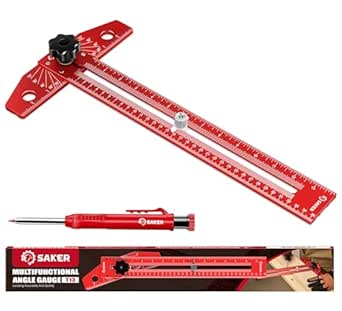 | Best for Combined Straight and Angled Layout | Material: Aluminum alloy | Measurement range: 0–48 cm (0–18 inches) | Dimensions: 18.89 × 7.87 inches | VIEW LATEST PRICE | See Our Full Breakdown |
| Milescraft 8408 CenterFinder Center Scriber and Offset Marking Tool |  | Best for Centerlines and Repeatable Offsets | Brand and model: Milescraft 8408 | Material: ABS | Board thickness capacity: Up to 2.5 inches | VIEW LATEST PRICE | See Our Full Breakdown |
| WEN Pocket Marking Edge Ruler (ME899R) |  | Best Compact Imperial Marking Ruler | Brand and model: WEN ME899R | Material: Anodized aluminum | Graduation range: 1/32 inch | VIEW LATEST PRICE | See Our Full Breakdown |
| Kreg Multi-Mark Multi-Purpose Marking & Measuring Tool (KMA2900) |  | Best for Repeatable Trim and Miter Layout | Brand and model: Kreg KMA2900 | Part number: KMA2900 | Item type: Measuring tool | VIEW LATEST PRICE | See Our Full Breakdown |
| WEN Pocket Marking T-Ruler (ME851R) |  | Best Compact Metric T-Ruler | Brand and model: WEN ME851R | Material: Aluminum | Graduation range: 1 millimeter | VIEW LATEST PRICE | See Our Full Breakdown |
| woodworking marking and measuring tool | Brand | Material |
|---|---|---|
| Clarke Brothers Wheel Marking | Clarke Brothers | — |
| Milescraft 8406 Exactor 9-in-1 | Milescraft | — |
| ARTYMASTER WT102A 3.8-Inch 3D | ARTYMASTER | Anodized aluminum alloy |
| 9-Piece Aluminum Woodworking M | — | Aluminum alloy |
| Precision Woodworking Square | AKNgoes | — |
| WEN ME251R 10-Inch Aluminum Of | WEN | Aluminum |
| Nicpro Mechanical Carpenter Pe | Nicpro | — |
| Taytools Solid Brass Precision | — | — |
| KAKURI Japanese Wood Marking G | KAKURI | — |
| BOXmime Euro Wheel Marking Gau | BOXmime | Aluminum alloy and alloy steel |
| Saker Aluminum Alloy Woodworki | — | Aluminum alloy |
| Milescraft 8408 CenterFinder C | — | ABS |
| WEN Pocket Marking Edge Ruler | — | Anodized aluminum |
| Kreg Multi-Mark Multi-Purpose | — | — |
| WEN Pocket Marking T-Ruler | — | Aluminum |
More Details on Our Top Picks
Clarke Brothers Wheel Marking Gauge with 2 Replacement Cutters
For laying out lines parallel to an edge, I rank the Clarke Brothers Wheel Marking Gauge ahead of the Milescraft 8406 Exactor because its job is more focused: set a distance, then guide a cutter along the wood. The laser-engraved inch and metric scale makes setting that offset straightforward, while the knurled grip and one-handed design support controlled use. Its brass, steel, and aluminum alloy construction is a sturdier, more specialized choice than the Milescraft’s multi-function format, and two replacement cutters extend its usefulness when a cutting edge wears. The tradeoff is range: graduations stop at 6 inches, so it is not a substitute for a longer rule or a square. I would choose it for consistent edge-referenced layout, not general measuring.
Pros:- Laser-engraved graduations use both inch and metric units.
- Wheel cutter supports controlled marking parallel to a flat edge.
- Includes two replacement steel cutters.
- Brass, steel, and aluminum alloy construction with a knurled grip.
Cons:- Graduated scale reaches only 6 inches (150 mm).
- Not water resistant.
- Specialized for edge-parallel marking rather than broad measuring tasks.
Best for: Woodworkers who regularly mark consistent offsets from board edges and want both inch and metric graduations.
Not ideal for: Buyers who need measurements beyond 6 inches, a multi-function layout tool, or equipment suited to wet storage.
- Brand:Clarke Brothers
- Model:WMG8
- Tool length:8 inches
- Graduated scale:Up to 6 inches (150 mm), inch and metric
- Materials:Brass, steel, and aluminum alloy
- Included cutters:Two replacement steel cutters
- Grip:Knurled
- Hand orientation:Ambidextrous
Our verdict“Choose this gauge for repeatable edge offsets and cutter-based marks; choose the Milescraft 8406 if you need a broader mix of measuring and layout functions.”
Milescraft 8406 Exactor 9-in-1 Measuring and Marking Tool
The Milescraft 8406 Exactor earns its place for buyers who want several layout references in one compact tool, rather than the focused edge-marking action of the Clarke Brothers wheel gauge. It works as a T-square for inside and outside corners and adds dual levels, a sliding bevel, and a depth gauge, plus 45-degree miter measurements and a 3/16-inch reveal. That mix can reduce tool changes when a project calls for transferring measurements, checking corners, and scribing. The compromise is reach: at 8.75 by 5.75 inches, its working area may be limiting on larger panels or long stock. Its metal-and-plastic construction also gives it a different feel from the Clarke Brothers’ brass-and-steel gauge. I see it as a versatile bench-side helper, not a replacement for full-size squares and rules.
Pros:- Combines measuring, marking, and measurement-transfer functions.
- Built-in dual levels, sliding bevel, and depth gauge broaden layout options.
- Measures 45-degree miters and inside and outside 90-degree corners.
- Can serve as a T-square for inside and outside corners.
Cons:- Compact dimensions can limit use on larger workpieces.
- Metal-and-plastic construction is less focused on a dedicated cutting-gauge task.
- A multi-function format may be less direct than a single-purpose gauge for repeated edge offsets.
Best for: Small-shop woodworkers and DIYers who want one compact tool for corner checks, bevel references, depth checks, and scribing.
Not ideal for: Woodworkers who routinely lay out large panels or need a dedicated cutter gauge for repeated parallel lines.
- Brand:Milescraft
- Model:84060003
- Materials:Metal and plastic
- Dimensions:8.75 × 5.75 inches
- Built-in features:Dual levels, sliding bevel, and depth gauge
- Angle and corner measurements:45-degree miters; inside and outside 90-degree measurements
- Additional functions:3/16-inch reveal, measurement transfer, and scribing
- Warranty:1-year limited
Our verdict“Pick the Exactor when compact versatility matters more than the Clarke Brothers gauge’s focused, repeatable edge marking.”
ARTYMASTER WT102A 3.8-Inch 3D Multi-Angle Measuring Square with Carpenter Pencil and 6 Refills
The ARTYMASTER WT102A is the compact specialist in this group: its three-dimensional scales support length, width, height, and angle checks in a tool only 3.8 inches across. That makes it more suited to small components and quick reference marks than the 6-inch AKNgoes square, whose longer blade and wide base favor machine setup and broader stock. Its 0°–90° angle range and laser-engraved imperial graduations add useful layout flexibility, and the included carpenter pencil, sharpener, refills, and Allen wrench make it ready for marking. The limitation is also clear: measurements stop at 3.8 inches, and there are no metric graduations. I would choose it for compact parts and multi-face checks, not as my only square for full-size woodworking.
Pros:- Three-dimensional scales cover length, width, height, and angles.
- Laser-engraved imperial graduations are designed to resist fading.
- Measures angles from 0° to 90°.
- Includes a carpenter pencil, built-in sharpener, six refills, and Allen wrench.
Cons:- Compact measurement range stops at 3.8 inches.
- Imperial graduations only.
- Short body is less suited to larger stock and machine setup than the 6-inch AKNgoes square.
Best for: Woodworkers laying out small parts who want a pocket-sized square for multiple faces and angle references, with marking supplies included.
Not ideal for: Buyers who need longer measurements, metric units, or a stable square for machine setup on larger workpieces.
- Brand:ARTYMASTER
- Model:WT102A
- Material:Anodized aluminum alloy
- Dimensions:3.8 × 3.3 × 2.8 inches
- Graduation range:1/16 to 3.8 inches
- Measurement system:Imperial
- Angle range:0° to 90°
- Included accessories:Carpenter pencil with built-in sharpener, six 2.8 mm refills, and Allen wrench
Our verdict“Choose the WT102A for small parts and multi-face layout; opt for the AKNgoes square when a longer blade and hands-free setup matter more.”
9-Piece Aluminum Woodworking Measuring and Scribing Tool Set with Storage Case
For someone building a layout kit from scratch, this set offers broader task coverage than the single-purpose Clarke Brothers gauge or the compact ARTYMASTER square. Its listed contents include an angle ruler, dovetail gauge, scriber, and marking tools, giving a buyer several kinds of references in one organized case. The aluminum alloy tools and machined surfaces are intended for regular measuring and marking, while the red storage case keeps the pieces together for transport and shop storage. The main drawback is uncertainty: the listing calls it both a 9-piece set and 10 pieces, and it does not identify every tool or provide individual dimensions. That makes it harder to judge whether the kit fits a particular workflow. I would favor it for breadth and organization, not for buyers who need a precisely specified tool selection.
Pros:- Includes several layout categories, including an angle ruler, dovetail gauge, and scriber.
- Aluminum alloy tools have machined surfaces.
- Storage case organizes the tools and supports transport.
- Set is intended for measuring, marking, and woodworking layout tasks.
Cons:- Piece count is inconsistent between the 9-piece title and 10-piece listing.
- Individual tool identities and dimensions are not fully specified.
- The broad kit description makes it difficult to confirm fit for a particular layout workflow.
Best for: New woodworkers assembling a varied layout kit who value a portable case and tools for measuring, scribing, and joinery marking.
Not ideal for: Experienced buyers who need an exact piece count, specific tool dimensions, or a clearly documented substitute for a dedicated precision square.
- Material:Aluminum alloy
- Listed set size:9-piece in title; listing also states 10 pieces
- Case dimensions:290 × 220 × 90 mm
- Case color:Red
- Named kit contents:Angle ruler, dovetail gauge, scriber, and marking tools
- Intended tasks:Measuring, marking, layout, and woodworking projects
Our verdict“Choose this set to fill several basic layout needs at once, but choose a specified standalone square or gauge when exact tool details matter.”
Precision Woodworking Square – 6 Inch Scriber Marking Ruler
The AKNgoes 6-inch square is the strongest fit here for bench layout and machine setup, where a stable base can matter more than portability. Its wide, self-standing handle lets it sit without being held, a practical contrast with the compact ARTYMASTER WT102A, which is built for small-part checks. The stainless steel blade carries 1/16-inch laser-engraved graduations and scribing notches, while the aluminum alloy handle adds a base for calibration and marking. A mechanical pencil and two boxes of leads are included, and the stated two-year warranty is longer than the one-year limited warranty listed for the Milescraft Exactor. Its 6-inch reach and imperial-only scale still impose limits; larger stock and metric workflows call for other tools. I would choose it for controlled short-range setup, not long measurements.
Pros:- Stainless steel blade with laser-engraved 1/16-inch markings.
- Built-in scribing notches combine measuring and marking.
- Wide self-standing base supports hands-free setup and calibration.
- Includes a mechanical pencil and two boxes of leads.
Cons:- Six-inch length may not reach across larger workpieces.
- Imperial graduations only.
- The wider base favors stable setup over the ARTYMASTER’s more compact form.
Best for: Woodworkers who make frequent short-range bench or machine checks and want a square that can stand hands-free while they mark.
Not ideal for: Buyers working with large panels, needing metric graduations, or seeking a compact multi-face square for small components.
- Brand:AKNgoes
- Part number:Akn-sq06
- Blade material:Stainless steel
- Handle material:Aluminum alloy
- Length:6 inches
- Dimensions:6 × 3.5 inches
- Graduations:Laser-engraved lines every 1/16 inch; imperial
- Included items:Precision square, mechanical pencil, and two boxes of leads
- Warranty:2 years
Our verdict“Choose the AKNgoes square for hands-free short-range layout and machine checks; choose the ARTYMASTER for compact, multi-face work.”
WEN ME251R 10-Inch Aluminum Offset Marking Gauge and Layout Tool with Laser-Etched Scale
The WEN ME251R is the pick here for woodworkers who want a marking gauge that doubles as a finely graduated layout tool. Its stated .002-inch accuracy and dual imperial-metric Vernier scale suit work where small adjustments matter, while laser-etched markings are less prone to fading than printed graduations. Compared with the BOXmime Euro Wheel Marking Gauge, the WEN offers a longer 10-inch format and a Vernier scale rather than a stated 6-inch range. That makes it more versatile for measuring offsets, though it is not a direct substitute for a wheel-style gauge when scribing a clean line along an edge. The aluminum body keeps the tool sturdy, but the single length limits reach on larger stock, and buyers seeking digital readout features will need another approach.
Pros:- Stated .002-inch accuracy supports fine adjustments
- Dual imperial and metric Vernier scale
- Laser-etched markings are designed for lasting legibility
- Aluminum construction provides a sturdy body
Cons:- The 10-inch format may not reach across larger workpieces
- No digital readout or electronic measurement features
- Offset layout use differs from a dedicated edge-scribing wheel gauge
Best for: Woodworkers who make fine, repeatable layout adjustments and want both imperial and metric graduations in one tool.
Not ideal for: People laying out long workpieces or seeking a dedicated cutting gauge or electronic measurement display.
- Brand:WEN
- Model:ME251R
- Tool type:Offset marking gauge and layout tool
- Length:10 inches
- Material:Aluminum
- Scale:Dual metric and imperial Vernier, laser-etched
- Stated accuracy:.002 inch
Our verdict“Choose the WEN ME251R for precise, dual-unit layout adjustments, but pick a longer-reach tool for oversized stock.”
Nicpro Mechanical Carpenter Pencil Set with Case, Sharpener, and 26 Refills
When a standard carpenter pencil cannot reach a mark, the Nicpro set’s 45 mm extended tip is its defining advantage. The two mechanical pencils, thick 2.8 mm HB refills, and built-in sharpener make it a practical marking kit for holes, corners, and other confined spots. Unlike the KAKURI Japanese Wood Marking Gauge, which creates a controlled parallel line from an edge, Nicpro is for drawing marks wherever the pencil tip can reach; it is more adaptable across materials but does not set or scribe a measured offset. The included case keeps the spare leads and sharpener together, although the lead is limited to HB and may not suit every surface or marking preference. Water resistance is specified, not waterproofing, so this set is not a replacement for durable layout marks in wet conditions.
Pros:- Extended 45 mm tip reaches into narrow openings
- Thick 2.8 mm lead is intended to resist breakage
- Includes two pencils, 26 refills, a sharpener, and a storage box
- Can mark wood, metal, plastic, and paper
Cons:- Refills are HB only
- Water resistance does not mean waterproof performance
- Does not provide a scale or repeatable edge offset
Best for: Carpenters and installers who need to mark inside narrow holes or tight recesses and want spare leads stored with their pencils.
Not ideal for: Woodworkers who need calibrated parallel lines, a cutting gauge, or different lead hardness options.
- Brand:Nicpro
- Included components:2 carpenter pencils, 26 refills, 1 replaceable sharpener, 1 plastic storage box
- Lead diameter:2.8 mm
- Tip length:45 mm
- Lead hardness:HB
- Grip:Ergonomic
- Materials:ABS and metal
- Water resistance:Water resistant
Our verdict“Pick Nicpro for versatile pencil marks in confined spaces, not for measured or scribed layout lines.”
Taytools Solid Brass Precision Marking and Cutting Gauge with Micro-Adjust Head and 2 Extra Cutters
For joinery layout where a knife-like cut matters more than a long measuring range, the Taytools gauge brings a micro-adjustable head and hardened steel cutter to the task. The cutter is designed to slice across wood grain, helping establish a crisp line for fitting joints, and it retracts into the head for protection between uses. Compared with the KAKURI Japanese Wood Marking Gauge, this is the more specialized choice for cutting-style marks and fine adjustment; KAKURI offers a wider stated reach, while Taytools trades range for a brass adjustment assembly and two spare cutters. Its 7-inch beam can restrict work on wider stock, and its cutting action is less suited to users who only need quick pencil marks. It is a focused layout tool, not a general-purpose ruler.
Pros:- Micro-adjustable head supports fine layout changes
- Hardened steel cutter is designed to slice across the grain
- Cutter retracts into the head for storage
- Two extra cutters are included
Cons:- The 7-inch beam limits marking reach
- Cutting-gauge design is specialized for woodworking layout
- A cutter-based mark may not suit every surface or marking task
Best for: Joinery-focused woodworkers who need finely adjusted, cut lines for fitting parts and value replaceable cutters.
Not ideal for: Buyers marking wide panels or looking for a simple pencil gauge with broad general-purpose use.
- Manufacturer:Taylor Toolworks
- Model:MGB
- Materials:Brass and hardened steel
- Beam length:7 inches
- Beam diameter:5/16 inch
- Head diameter:1.625 inches
- Cutter diameter:0.375 inch
- Weight:8.8 ounces
- Included cutters:2 extra
Our verdict“Choose Taytools for precise cut lines in joinery, but opt for a longer gauge when marking broad stock.”
KAKURI Japanese Wood Marking Gauge, Adjustable to 4.7 Inches
The KAKURI KEBIKI favors straightforward edge-to-line marking over the fine adjustment hardware found on the Taytools gauge. Set its width by hand, secure the screws, and the Japanese carbon steel blade scribes a parallel line from the wood edge. Its laminated bamboo body weighs 4.2 ounces, making it an easy tool to hold and carry, while the blade retracts into the body for storage. The maximum 120 mm reach is wider than the Taytools gauge’s 7-inch beam in practical marking span, but KAKURI lacks Taytools’ described micro-adjustable head and spare cutters. That makes it a simpler choice for routine carpentry layout, not the stronger fit for fine cutter adjustment. The bamboo body is not water resistant, so damp work areas call for care.
Pros:- Adjustable to a maximum marking width of 120 mm
- Japanese carbon steel blade retracts into the body
- Lightweight laminated bamboo construction
- Hand-turn screws secure the setting
Cons:- Maximum marking width is limited to 120 mm
- Body is not water resistant
- Hand-set adjustment is less specialized than the Taytools micro-adjust head
Best for: Carpenters who want a lightweight, hand-adjusted gauge for repeatable parallel lines on wood up to 120 mm from an edge.
Not ideal for: Woodworkers who need micro-adjustment, a longer marking range, or a tool suited to wet conditions.
- Brand:KAKURI
- Model number:41451
- Maximum marking width:120 mm (4.7 inches)
- Dimensions:5.3 × 2.3 × 7.2 inches
- Weight:4.2 ounces (120 g)
- Blade material:Japanese carbon steel
- Body material:Laminated bamboo
- Made in:Japan
Our verdict“Pick KAKURI for lightweight, straightforward parallel marking, but choose Taytools if fine cutter adjustment is your priority.”
BOXmime Euro Wheel Marking Gauge for Woodworking
The BOXmime Euro Wheel Marking Gauge suits woodworkers who want a compact, ruler-marked tool for setting and scribing an edge offset. Its wide circular base and locking knob support steady contact as the replaceable stainless steel tip follows the work, while permanent inch and millimeter scales let you set distances without a separate ruler. Compared with the WEN ME251R, BOXmime is more clearly dedicated to wheel-gauge marking and has a replaceable tip, but its stated 6-inch range is shorter than WEN’s 10-inch format. The CNC-machined aluminum body is rigid and rust-resistant, yet this is still a layout tool rather than a general measuring instrument. Buyers needing longer offsets or a precision Vernier-style scale should look at WEN instead.
Pros:- Laser-etched inch and millimeter scales
- Machined aluminum body is rigid and rust-resistant
- Replaceable stainless steel tip
- Locking knob and wide circular base support steady marking
Cons:- Measurement range is limited to 6 inches or 150 mm
- Designed for marking and layout rather than general measurement
- Shorter stated range than the WEN ME251R
Best for: Woodworkers who want a stable, dual-unit wheel gauge for repeatable edge offsets within a 6-inch range.
Not ideal for: People marking offsets beyond 6 inches or seeking a general-purpose measuring tool with Vernier graduations.
- Brand:BOXmime
- Model:BOX-WMG01
- Material:Aluminum alloy and alloy steel
- Scale:0–6 inches / 0–150 mm
- Tip:Replaceable stainless steel
- Dimensions:9.01 × 2.75 × 0.74 inches
- Included items:1
Our verdict“Choose BOXmime for stable, scaled wheel-gauge marks up to 6 inches, and choose WEN for a longer measurement format.”
Saker Aluminum Alloy Woodworking T-Square Ruler with Adjustable Angle Finder
The Saker combines a T-square, ruler, and adjustable angle finder, making it a practical choice when a project calls for both straight marks and angled layout without switching tools. Its laser-engraved scales are designed to stay legible, and the included mechanical pencil with refills lets you start marking without adding a separate pencil to the setup. Compared with the Kreg Multi-Mark, the Saker offers a longer stated measuring range and an integrated T-square format; the Kreg instead provides three scale configurations and both imperial and metric markings. The tradeoff is that the Saker’s range stops at 48 cm, and changing its angle requires loosening a nut. I’d choose it for varied small-to-medium layout jobs, not for long-board measurements or rapid angle changes.
Pros:- Combines ruler, T-square, and adjustable angle finder functions.
- Laser-engraved scales are designed for durable readability.
- Aluminum alloy body balances low weight with a sturdy feel.
- Includes a mechanical carpenter pencil and eight refills.
Cons:- Measurement range is limited to 48 cm (18 inches).
- Angle changes require loosening the adjustment nut.
Best for: Woodworkers who want one compact tool for straight-edge layout, T-square marking, and adjustable angles on small-to-medium workpieces.
Not ideal for: Builders laying out long boards or changing angles repeatedly, since the scale tops out at 48 cm and angle adjustment requires loosening a nut.
- Material:Aluminum alloy
- Measurement range:0–48 cm (0–18 inches)
- Dimensions:18.89 × 7.87 inches
- Scale markings:Laser engraved
- Included components:Carpenter pencil with 8 refills
- Item weight:449 g
Our verdict“Choose the Saker if you want a single tool for straight and angled layout, but pick the Kreg Multi-Mark if its three scale positions and dual measurement systems better match your work.”
Milescraft 8408 CenterFinder Center Scriber and Offset Marking Tool
The Milescraft CenterFinder focuses on a specific layout problem: drawing a centerline along a board or repeating an offset without estimating from either edge. Its guide posts contact the wood as you rotate the tool, while the center hole holds a pencil; notches provide offsets from 1/16 to 5/8 inch in 1/16-inch steps. That makes it more specialized than the Saker T-Square, which covers broader straight and angled layout, but more direct when centered or parallel lines are the main task. The ABS body keeps the tool light, and a built-in magnet and pencil storage help keep it close at hand. Its limits are clear: boards must be no thicker than 2.5 inches, and marks are made with a pencil rather than a cutting wheel.
Pros:- Marks centerlines along board faces or edges.
- Provides ten offset settings from 1/16 to 5/8 inch.
- Rare earth magnet and built-in pencil storage aid shop organization.
- Lightweight design is easy to keep near a layout station.
Cons:- Limited to boards up to 2.5 inches thick.
- Designed for pencil marking rather than a cutting or scribing edge.
Best for: Cabinetmakers and furniture builders who frequently mark centerlines or repeat small, measured offsets on boards up to 2.5 inches thick.
Not ideal for: Woodworkers needing a general-purpose angle square, marking knife, or centerline layout on stock thicker than 2.5 inches.
- Brand and model:Milescraft 8408
- Material:ABS
- Board thickness capacity:Up to 2.5 inches
- Offset range:1/16 to 5/8 inch in 1/16-inch increments
- Included components:CenterFinder tool and #2 pencil
- Magnet:Rare earth
- Dimensions:19.69 × 0.59 × 0.98 inches
- Weight:0.06 kg
- Warranty:2-year limited
Our verdict“Pick the CenterFinder for repeatable centerlines and offsets; choose the WEN ME899R instead if you need a pocket ruler for a wider range of marking tasks.”
WEN Pocket Marking Edge Ruler (ME899R)
The WEN ME899R is for layout work where a small ruler needs to stay steady against an edge. Its wraparound profile helps resist slipping, while 1 mm marking holes spaced every 1/32 inch support repeated parallel lines, including mortise layout. The CNC-machined, anodized aluminum body is rust-resistant and compact enough to keep in a pocket or palm. Compared with the Milescraft CenterFinder, this ruler is less focused on centering a board and better suited to a range of short, edge-referenced marks; the CenterFinder offers dedicated centerline and offset settings instead. The ME899R’s small format is also its main compromise: it is handy for detail work but not a substitute for a long rule when laying out large panels. Its listed graduations are fractional-inch increments, while the WEN ME851R uses metric spacing.
Pros:- Wraparound edge helps stabilize the ruler against a workpiece.
- 1 mm holes spaced every 1/32 inch support fine marking increments.
- CNC-machined anodized aluminum is rust-resistant.
- Pocket-sized form is convenient for detail layout.
Cons:- Compact length is less useful for measuring large workpieces.
- The small marking format is less suited to broad layout than a full-size square or ruler.
Best for: Woodworkers who make frequent short, fractional-inch marks and parallel layout lines on small parts or along workpiece edges.
Not ideal for: Anyone laying out long boards or large panels, or who wants a dedicated centerline tool with preset offsets.
- Brand and model:WEN ME899R
- Material:Anodized aluminum
- Graduation range:1/32 inch
- Marking hole size:1 mm
- Item weight:3.2 ounces
- Unit count:1
Our verdict“Choose the ME899R for portable fractional-inch detail marking, while the Saker T-Square is a better fit for longer straight and angled layout.”
Kreg Multi-Mark Multi-Purpose Marking & Measuring Tool (KMA2900)
The Kreg Multi-Mark earns its place for users who need a repeatable setup for trim, reveals, and mitered corners, rather than a simple ruler alone. Its three scale configurations—standard, 90°, and 45°—let one gauge support several common layout jobs, and imperial and metric markings help when plans or components use different systems. Compared with the Saker T-Square, the Kreg puts more emphasis on preset layout configurations, while the Saker combines an adjustable angle finder with a longer stated ruler range. The Kreg’s materials include alloy steel, stainless steel, and plastic polymer, but the supplied details do not give a measurement range or a digital readout. That makes it a focused manual gauge, not a long measuring rule or electronic tool. I’d favor it for repeat work over broad, one-off measuring.
Pros:- Three scale configurations support standard, 90°, and 45° layout.
- Dual imperial and metric markings suit mixed-unit plans.
- Adjustable gauge format supports repeatable setup work.
- Material mix includes alloy steel and stainless steel.
Cons:- Designed primarily for woodworking rather than general trade use.
- No digital readout or electronic measurement features.
- The provided product data does not state a measurement range.
Best for: Trim carpenters and furniture makers who need repeatable 90° and 45° layouts, reveal settings, and both imperial and metric scales.
Not ideal for: Woodworkers seeking a long ruler, a specified extended measurement range, or digital measurement features.
- Brand and model:Kreg KMA2900
- Part number:KMA2900
- Item type:Measuring tool
- Materials:Alloy steel, plastic polymer, stainless steel
- Color:Blue
- Scale configurations:Standard, 90°, 45°
- Measurement systems:Imperial and metric
- Unit count:1
Our verdict“Choose the Multi-Mark for repeatable trim and miter layout in either measurement system, but select the Saker if a longer stated ruler range and adjustable angle finder matter more.”
WEN Pocket Marking T-Ruler (ME851R)
The WEN ME851R is the compact pick for woodworkers who want a small T-ruler with metric marking intervals ready for quick layout. Its 1 mm holes, spaced every 1/32 inch along the ruler, allow pencil marks at close intervals, while CNC-machined anodized aluminum gives the pocket-sized tool a rust-resistant body. Compared with the WEN ME899R, this model is lighter and specified for metric graduations; the ME899R is the more flexible choice for users who work primarily in fractional inches. The ME851R’s limitation is not just its short format: the product data lists its graduation range in millimeters, so buyers who rely on clearly stated imperial graduations may prefer the ME899R or the dual-system Kreg Multi-Mark. It suits detail work, but it cannot replace a full-size rule for longer measurements.
Pros:- Compact design fits easily in a pocket or hand.
- 1 mm marking holes spaced every 1/32 inch support close-interval layout.
- CNC-machined anodized aluminum is rust-resistant.
- Lightweight at 1.6 ounces.
Cons:- Listed graduation range is metric, which may not suit imperial-only workflows.
- Pocket-sized format is not intended for long measurements.
Best for: Woodworkers who prefer metric layout and want a lightweight T-ruler for small parts, mortises, and quick marks at the bench.
Not ideal for: Users who need a long measuring rule or clearly specified imperial graduations for fractional-inch layout.
- Brand and model:WEN ME851R
- Material:Aluminum
- Graduation range:1 millimeter
- Marking hole spacing:Every 1/32 inch
- Item weight:1.6 ounces
- Style name:Compact
- Style color:Black
- Unit count:1
Our verdict“Choose the ME851R for lightweight metric detail layout, but opt for the WEN ME899R if fractional-inch graduations are your priority.”

How We Picked
I compared these 15 woodworking marking and measuring tools by the layout jobs they support: transferring dimensions, marking parallel lines, checking or establishing angles, locating centers, and making repeatable scribe marks. I gave more weight to usable accuracy, clear adjustment and reading, stability against a workpiece, and whether the design helps reduce setup errors. Build materials, replacement marking parts, included accessories, portability, and storage also mattered because they affect how well a tool fits regular shop use.
The ranking favors tools with a clear role and useful range, not simply the largest number of claimed functions. That puts the Milescraft 8406 Exactor first as the most broadly useful option, while the Taytools precision gauge ranks higher for fine gauge work and the compact WEN tools suit quick reference tasks. Dedicated gauges, squares, scribers, and pencils remain strong picks when their specific job matters more than versatility; a wider feature set does not automatically mean a better fit for every bench.
| woodworking marking and measuring tool | Material |
|---|---|
| Clarke Brothers Wheel Marking | — |
| Milescraft 8406 Exactor 9-in-1 | — |
| ARTYMASTER WT102A 3.8-Inch 3D | Anodized aluminum alloy |
| 9-Piece Aluminum Woodworking M | Aluminum alloy |
| Precision Woodworking Square | — |
| WEN ME251R 10-Inch Aluminum Of | Aluminum |
| Nicpro Mechanical Carpenter Pe | — |
| Taytools Solid Brass Precision | — |
| KAKURI Japanese Wood Marking G | — |
| BOXmime Euro Wheel Marking Gau | Aluminum alloy and alloy steel |
| Saker Aluminum Alloy Woodworki | Aluminum alloy |
| Milescraft 8408 CenterFinder C | ABS |
| WEN Pocket Marking Edge Ruler | Anodized aluminum |
| Kreg Multi-Mark Multi-Purpose | — |
| WEN Pocket Marking T-Ruler | Aluminum |
Factors to Consider When Choosing Woodworking Marking And Measuring Tools
Before choosing among these tools, start with the marks you make most often and how those marks guide the cut or joint. Accuracy depends on the full layout process, including the reference edge, marking method, and ability to repeat a setting—not just the scale on the tool.
Match the tool to the mark, not the product category
A pencil line works well for rough cutting allowances, while a fine scribed line can give a sharper reference for a close-fitting joint. A marking gauge is useful for lines parallel to an edge; a square or ruler is better for setting out straight measurements and right angles. Centering tools address a different problem again, so they should not be bought as substitutes for a general measuring rule. A common mistake is expecting one multi-purpose tool to perform every task with the same control as a dedicated instrument. List the operations you repeat most, then choose the tool that makes those marks easy to set and reproduce.
Check how adjustments lock and repeat
For repeated measurements, the ability to hold a setting matters as much as how finely the tool can be adjusted. Look for controls that are easy to set without shifting the reference, and consider whether the scale or adjustment is readable from your usual working position. A tool that offers many settings can slow work if each one takes fiddling to secure. Before relying on a new gauge for a batch of parts, set it once and check several marks against a known reference. This simple habit can reveal looseness or reading errors before they carry through a project.
Treat the workpiece edge as part of the measurement
Many marking tools reference an edge, so a chipped, rounded, or out-of-square edge can make a precise-looking line misleading. Decide whether you need a tool that registers against a narrow edge, spans a wider surface, or reaches across an angled layout. Compact edge tools are convenient at the bench, but they may offer less support on broad stock than a longer square or rule. Do not assume a longer tool is always more accurate; extra length can be awkward in tight spaces and may flex if handled poorly. Establish a dependable reference face and edge before comparing dimensions from one part to another.
Choose between pencil lines and scribed lines
Pencils are easy to erase and suit general layout, but a thick or worn point can obscure a fine measurement. Mechanical carpenter pencils help keep a usable point close at hand, though lead condition and sharpening still affect line width. A cutting or wheel gauge can create a more distinct boundary, which can help when the mark needs to guide a chisel or saw. That sharper mark is less forgiving: a misplaced scribe line may remain visible or cut the wrong face. Match the marking method to the material, finish, and consequence of an error rather than choosing by habit alone.
Pay for control or versatility where you will use it
A precision adjustment mechanism or durable metal construction can make sense for repeated fine layout, where small shifts affect fit. A multi-function tool is more appealing when it replaces several occasional-use items and saves setup time. Neither approach is automatically better: a feature-rich design can be harder to read or handle, while a specialist tool may sit unused between particular tasks. Consider whether replacement cutters, pencil refills, or a storage case matter for the way you maintain your shop. Spend extra for the feature that improves a recurring operation, not for functions that sound useful but rarely leave the drawer.
Plan for visibility, storage, and safe handling
Scale contrast and line visibility matter in a dusty shop or when working with dark woods, so check whether markings are easy to read under your normal lighting. Small tools are easy to keep nearby but also easy to misplace; a case or a consistent storage spot can help keep marking components together. Cutting gauges call for a little more care around exposed cutters than pencil-based tools. If a tool will move between work areas, favor a form that stays protected and can be checked for loose parts before use. Good storage preserves the tool’s usefulness and reduces the chance that a worn or damaged marking edge spoils a layout.
Frequently Asked Questions
Should I choose a marking gauge or a multi-purpose measuring tool first?
Choose based on the operation you repeat most often. If you regularly mark lines parallel to an edge for joinery or stock layout, a dedicated gauge is likely to feel more direct and consistent. If your projects call for several kinds of measurements and marks, a multi-purpose tool can reduce tool changes and bench clutter. A broad feature list does not guarantee that each function is equally quick to use. If possible, prioritize clear settings and a dependable reference surface over the number of functions.
When is a cutting gauge preferable to a pencil marking gauge?
A cutting gauge is useful when a crisp line needs to guide a chisel or define a joint boundary, since it scores the surface rather than leaving only a graphite mark. A pencil gauge is easier to erase and can be a better fit for rough layout or work where visible cuts are unwelcome. The choice also depends on the wood and finish: a scribe mark can show on a finished face or be hard to correct. Keep the reference edge consistent whichever style you choose. For delicate work, make a test mark on scrap before committing to the finished piece.
Do I need both a square and a T-square for woodworking layout?
Not always. A square is a straightforward choice for checking or establishing a right angle, while a T-square can offer a longer reference across a panel or sheet and may include angle-related features. If most work involves small parts, a larger T-square may take up space without adding much convenience. For panels or repeated crosswise layout, its longer reach can be useful. Match the tool’s size and registration method to the largest pieces you routinely mark, and verify its accuracy before using it as a reference.
What should I check before trusting a new ruler or square?
Check the tool against a reliable reference rather than assuming its scale or edge is accurate out of the package. For a square, draw a line along one edge, flip the tool, and compare the second line against the first; divergence can reveal an error. For a ruler, inspect whether the scale begins at the physical edge or has an offset that affects measurement. Also check for burrs, loose adjustment parts, and markings that are difficult to read. Recheck after a drop or any adjustment that could affect alignment.
Is a compact pocket tool accurate enough for furniture projects?
A compact tool can handle furniture layout when its measuring range and reference surfaces suit the task, but small size does not by itself prove accuracy. Short tools can be convenient for local marks and quick checks, yet they may be awkward for long baselines or wide panels. Use a longer reference when you need to transfer dimensions across a broad surface, and verify compact tools against a trusted rule or square. Also watch for parallax when reading a scale at an angle. The best setup may combine a pocket tool for frequent small tasks with a longer reference for major layout lines.
Conclusion
For one broadly useful starting point, I recommend the Milescraft 8406 Exactor as best overall; its 9-in-1 format suits varied layout without committing to one narrow task. The WEN Pocket Marking Edge Ruler is my best value-style pick for compact, quick reference work, while the Taytools Solid Brass Precision Gauge is the best premium choice for buyers who prioritize micro-adjusted scribing and cutting control. Beginners who want fewer separate tools can start with the Exactor, or choose the Kreg Multi-Mark for accessible everyday marking. For specific needs, pick the Milescraft CenterFinder for center and offset marks, a WEN pocket tool for compact layouts, or the Nicpro pencil set for routine visible marking. Match the tool to your most frequent task, then add a specialist only when your work calls for its added control.