
To decide if a round is better for a maul, wedge, or machine, consider your main goal. Use a maul if you need powerful impacts for breaking or splitting tough materials. Choose a wedge if you want to split or pry with precision, especially in cracks. Opt for a machine if your task requires detailed cuts, shaping, or grinding. Understanding these differences helps you pick the right tool for the job—more details can guide your choice further.

Get business pricing on tools and workshop supplies
- Business-only prices and quantity discounts
- Tax-exempt purchasing
- Multiple users, one account, clear invoices
Key Takeaways
- Assess the task’s force requirements: heavy impacts favor a maul, splitting needs suit a wedge, precision tasks require a machine.
- Consider the material being worked on: tough, dense materials benefit from a maul, while softer or split materials suit wedges or machines.
- Evaluate the desired accuracy: machines provide precision cuts, wedges offer controlled splitting, mauls deliver brute force.
- Determine the size and shape of the work area: larger, rough tasks are better for a maul, smaller or detailed work for a machine.
- Match the tool’s blade design and durability to the task complexity and frequency of use.
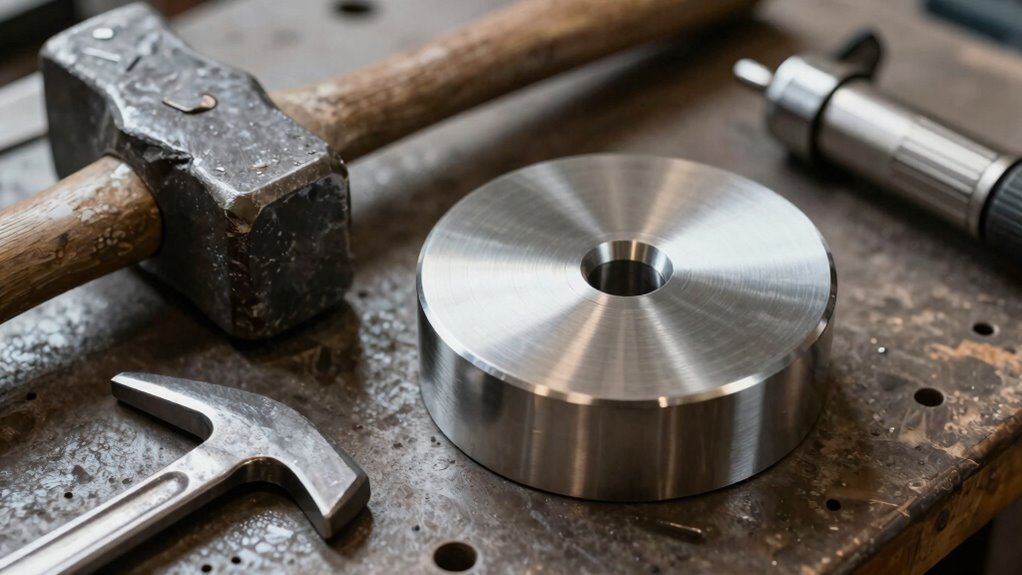
Choosing the right shape for a round in a game or tool depends on understanding how each option—maul, wedge, or machine—works best in different situations. When deciding whether a maul, wedge, or machine is most suitable, you need to consider the specific task you’re tackling, especially how the tool’s blade design and material selection influence performance. Each shape is optimized for certain conditions, and understanding these nuances helps you make an effective choice.
A maul typically features a broad, heavy head designed for delivering powerful blows. Its blade design prioritizes mass and impact force, making it ideal for breaking through tough materials or splitting wood. When choosing a maul, you should pay close attention to the material selection—look for high-grade steel or forged alloys that can withstand repeated impacts without deforming. The blade’s thickness and edge geometry are also vital; a thicker blade can absorb more shock, while a well-sharpened edge ensures efficient energy transfer during swings. If your work involves heavy-duty tasks requiring brute force, a maul with a robust blade design and durable material is your best bet.
In contrast, a wedge is shaped to facilitate splitting or prying tasks. Its blade design is usually narrow and tapered, allowing it to slide into cracks or gaps easily. Material selection for wedges is equally important—steel alloys with high tensile strength prevent bending or breaking under pressure. The blade’s geometry, often with beveled edges, helps direct force efficiently into splitting actions or lifting objects. When working with wood or materials prone to splitting, a wedge’s shape and toughness enable you to apply force precisely and with minimal effort. Choosing a wedge with a well-designed blade and strong material ensures it can withstand repeated use and withstand the forces you apply. Additionally, understanding blade geometry can help you select the most effective tool for your specific needs.
A machine, on the other hand, relies on mechanics and precise engineering. Its blade design is often more complex, optimized for cutting, grinding, or shaping materials with consistency. Material selection here focuses on hardness and wear resistance—think of hardened steel or carbide inserts that maintain sharpness over time. The shape of machine blades is engineered for specific functions, whether slicing, grinding, or drilling, and often involves intricate geometries to maximize efficiency. When accuracy and repeatability are your priorities, a machine with carefully designed blades and top-quality materials guarantees consistent performance. Additionally, advancements in blade technology have further enhanced the precision and durability of modern tools.
Products Worth Considering

Dyson Cyclone V10 Origin Cordless Vacuum

eufy Security eufyCam C37 4-Camera Kit with 360° Pan and Tilt, Auto Tracking, 2K Color Night Vision, and Solar Panels

Dyson V9 Motorbar Cordless Vacuum
As an affiliate, we earn on qualifying purchases.
Frequently Asked Questions
What Materials Are Best Suited for Round Tools?
You should choose materials with high hardness, such as high-speed steel or carbide, for round tools. These materials hold their edge well and resist wear, making them ideal for tool sharpening and durability. For softer materials, consider tools made from softer metals, but keep in mind they need more frequent sharpening. Harder materials guarantee efficient cutting and a longer lifespan, especially when working with tough or abrasive materials.
How Does Round Shape Affect Cutting Precision?
Imagine your tool as a finely tuned violin string—its shape impacts sound, just like how a round tool affects cutting precision. The round shape allows for smooth surface contact, reducing edge sharpness loss and minimizing chatter. This results in more consistent cuts. You notice that with a well-designed round tool, the surface contact guarantees a precise, clean finish, especially when working on curved surfaces, boosting your control and accuracy.
Are Round Tools More Durable Than Other Shapes?
Round tools often have a longer tool lifespan because their shape distributes stress evenly, reducing wear and tear. This shape also offers greater versatility, making them suitable for various tasks. You’ll find that round tools resist chipping and breakage better than some other shapes, ensuring durability over time. If you prioritize durability and flexibility in your projects, round tools are a reliable choice for maintaining performance and extending tool life.
Can Round Shapes Be Customized for Specific Tasks?
Yes, you can customize round shapes for specific tasks. You’ll find that their aesthetic versatility allows for various designs, blending form and function seamlessly. Plus, their ergonomic benefits make them easier to handle and manipulate during tasks. By tailoring the size, surface texture, and material, you guarantee the round shape fits your needs perfectly, enhancing both efficiency and comfort in your work.
What Safety Precautions Are Needed for Using Round Tools?
When using round tools, you need to prioritize safety. Always wear appropriate safety gear like goggles, gloves, and hearing protection. Handle the tools with proper techniques, gripping firmly and maintaining control to prevent slips. Keep your work area clean and free of obstructions. Make certain the tool is secure before starting, and never force it. Following these precautions helps protect you from injuries and ensures precise, safe operation.
Conclusion
Now that you know the ins and outs of choosing between maul, wedge, or machine for a round, you’re equipped to make smarter decisions. Think of it like steering through a maze—you’ll want the right tool to cut through obstacles smoothly. Trust your instincts, assess the material, and pick the option that best fits the situation. With this knowledge, you’re ready to tackle any challenge head-on, turning tricky rounds into a walk in the park.