Filing angles and depth gauges are essential tools for ensuring precision in your woodworking or metalworking projects. By mastering proper filing angles, you can sharpen blades, chisels, and cutters effectively, resulting in cleaner cuts and longer tool life. Depth gauges help you measure and control material removal for accurate joints and fits. Maintaining these tools correctly boosts your craftsmanship, making your work more professional and consistent. Keep exploring to discover how these techniques can elevate your skills even further.
Key Takeaways
- Proper filing angles ensure effective sharpening, improve cut quality, and extend tool lifespan.
- Depth gauges measure and control material removal for precise, consistent cuts and fitting.
- Maintaining correct filing angles prevents tool damage and enhances accuracy in metalworking and woodworking.
- Regular calibration and adjustments of depth gauges ensure reliable measurements during projects.
- Mastering these tools improves overall craftsmanship, project precision, and tool efficiency.
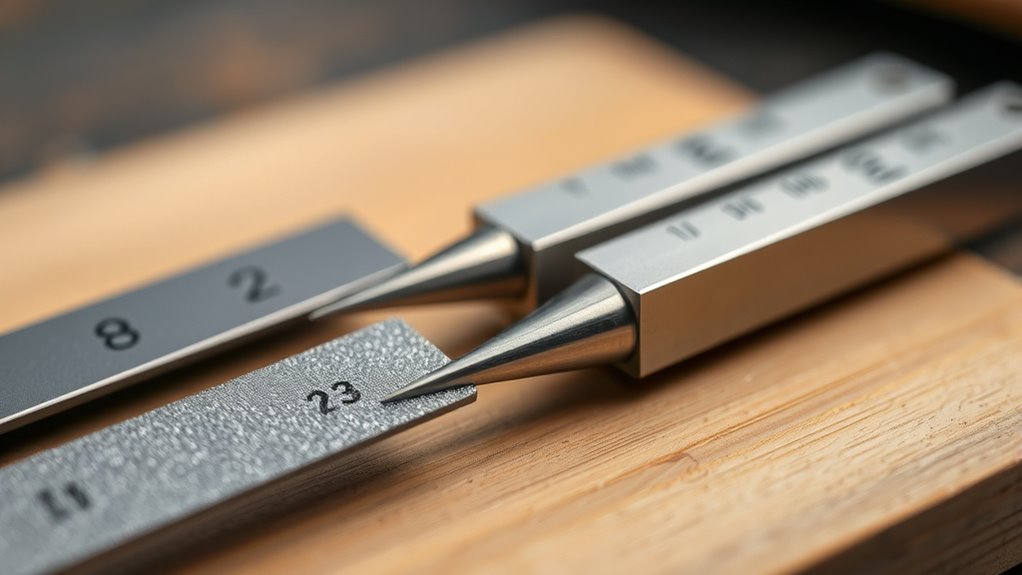
Filing angles and depth gauges are essential tools for precise metalworking and woodworking projects. They help you achieve accuracy in cuts, joint fits, and tool edges, which is crucial for professional-quality results. Understanding how to properly use these tools can significantly enhance your craftsmanship and ensure your tools remain in top condition. One of the key aspects of maintaining your tools is precision sharpening, and filing angles play a vital role in this process. When you maintain your tools with correct filing angles, you guarantee they cut efficiently and last longer. Proper tool maintenance involves regularly checking and adjusting these angles, preventing dullness and uneven wear that compromise your project quality.
Proper filing angles ensure efficient cuts and longer-lasting tools.
Using filing angles correctly starts with understanding their purpose. They guide you in sharpening blades, chisels, and other cutting tools at the exact angle needed for optimal performance. If the angle is too shallow or too steep, your tools won’t cut effectively, leading to more effort and poorer results. With practice, you’ll learn to set and maintain consistent filing angles, which helps you achieve precision sharpening every time. This consistency is essential because it ensures uniformity across your tools, producing cleaner, more accurate cuts. When you’re sharpening blades, for instance, a precise filing angle ensures the edge remains sharp longer, reducing the frequency of sharpening sessions and saving you time and effort. Regularly inspecting your tools and maintaining proper filing angles can also prevent unnecessary tool damage and ensure longevity.
Depth gauges complement filing angles by providing a reliable way to measure and control the depth of cuts or the amount of material removed. They’re especially handy when you need to replicate specific measurements or set precise depths for mortises, grooves, or other features. Using a depth gauge correctly involves understanding how to calibrate it and read measurements accurately. This allows you to maintain consistency across multiple parts or projects, which is critical in both metalworking and woodworking. When combined with proper filing techniques, depth gauges enable you to make fine adjustments that improve the overall fit and finish of your work.
Ultimately, mastering the use of filing angles and depth gauges enhances your skill set, making your projects more precise and professional. The key to success lies in regular tool maintenance—keeping your blades sharp at the right angles and measuring depths accurately ensures your tools work efficiently and last longer. Whether you’re sharpening a chisel or setting a cut depth, paying attention to these details improves both the quality and durability of your work. With practice, you’ll find that these tools become second nature, and your projects will reflect the precision and craftsmanship you endeavor for. Proper use of filing angles and depth gauges is an investment in your skills and your tools, ensuring every cut and measurement is spot on.

Wixey Digital Angle Gauge for Table Saw & Miter Saw, Magnetic
- High-Precision Measurement: 0.1° resolution, ±0.2° accuracy
- Compact & Portable: Lightweight design with auto shut-off
- Backlit LCD Display: Easy to read in dim lighting
As an affiliate, we earn on qualifying purchases.
As an affiliate, we earn on qualifying purchases.
Frequently Asked Questions
How Do I Choose the Right Filing Angle for Different Materials?
You should choose the right filing angle based on material compatibility and angle selection techniques. For softer materials like aluminum, use a gentler angle to avoid gouging, while harder materials like steel require sharper angles for precision. Always consider the specific material’s hardness and finish requirements. Use consistent angle selection techniques, such as maintaining a steady angle throughout the stroke, to ensure smooth, accurate filing results.
What Are Common Mistakes When Using Depth Gauges?
Think of using depth gauges like wielding a finely tuned compass—you need precision. Common mistakes happen when you ignore incorrect tool calibration or use improper technique, causing your measurements to drift like a ship off course. Always double-check calibration, and maintain steady, consistent pressure. Neglecting these steps can lead to inaccurate depths, wasting time and material. Stay vigilant, keep your tools calibrated, and your technique steady to navigate true measurement waters.
Can Filing Angles Be Adjusted Mid-Project?
Yes, you can adjust filing angles mid-project, but you should first check your tool calibration to guarantee accuracy. Carefully re-angle the file while maintaining safe filing practices to avoid slips or injuries. Remember, proper tool calibration helps ensure precise adjustments, and adhering to filing safety prevents accidents. Take your time, make small adjustments, and verify your angles frequently to achieve the best results without compromising safety.
What Maintenance Is Needed for Filing Tools?
You should regularly maintain your filing tools by sharpening them using proper sharpening techniques to keep them effective. Clean the files after each use with a wire brush to remove debris, and store them in a dry, organized space to prevent rust and damage. Proper storage best practices include keeping files in protective cases or wrapped in cloths, ensuring they stay sharp and ready for precise work whenever you need them.
Are Digital Depth Gauges More Accurate Than Manual Ones?
Digital depth gauges are generally more accurate than manual ones, like having a laser beam compared to a flashlight. You benefit from digital precision, which minimizes human error. However, to keep their accuracy, you need regular tool calibration. With proper care, digital gauges offer reliable measurements, making your work more precise and efficient. Just remember, even the sharpest tool needs regular tuning to stay on point.
Conclusion
Mastering filing angles and depth gauges guarantees your projects are precise. Imagine you’re restoring a vintage pocket watch; using the correct filing angle assures the gears mesh perfectly, preventing future issues. By practicing these techniques, you’ll gain confidence and accuracy in your craftsmanship. Remember, attention to detail makes all the difference—so keep honing your skills, and your work will stand the test of time. With patience and precision, you’ll turn your ideas into flawless results.