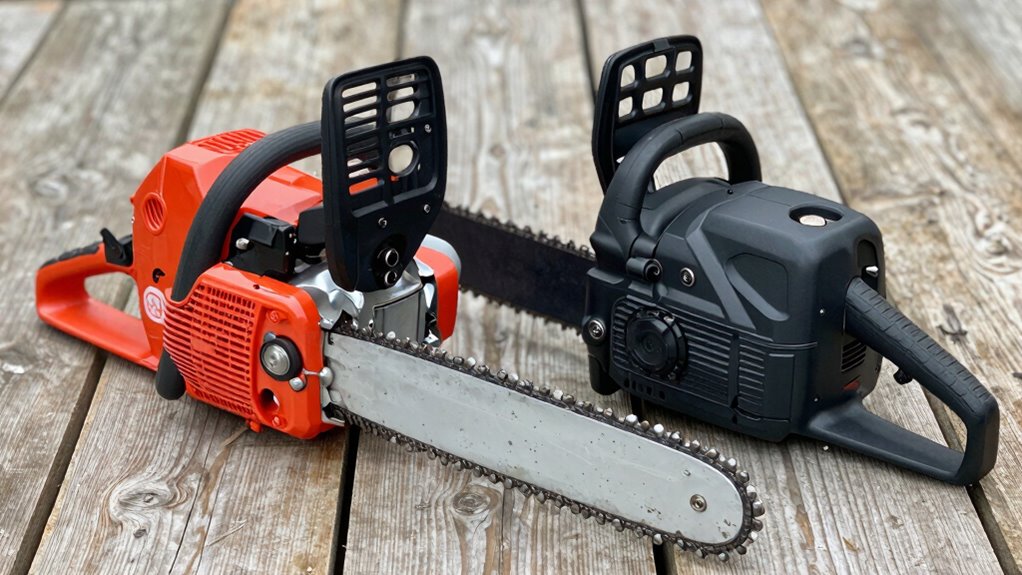
Choosing between gas and battery chainsaws isn’t a battle—you just need the right tool for your job. Gas models offer more power and endurance for heavy-duty tasks, while battery chainsaws are quieter, more eco-friendly, and great for lighter work. Your decision depends on project scope, environment, and personal preference. To discover how each option fits your needs and avoid common misconceptions, keep exploring the details that can help you make an informed choice.
Key Takeaways
- Both gas and battery chainsaws have unique advantages; choosing depends on project scope and environment.
- Gas chainsaws offer more power for heavy-duty tasks, while batteries excel in quiet, eco-friendly, lighter work.
- Noise levels, environmental impact, and convenience influence the suitability of each type for different users.
- Technological advancements are bridging performance gaps, making battery chainsaws increasingly capable for larger jobs.
- Selecting the right chainsaw is about matching tool features to specific needs, not about which is inherently better.

When choosing a chainsaw, you’ll quickly notice two main types: gas-powered and battery-powered. Both have distinct advantages, and understanding their differences can help you pick the right tool for your needs. One of the first things to consider is power efficiency. Gas chainsaws generally deliver more power, making them suitable for heavy-duty tasks like felling large trees or cutting thick logs. They run on fuel, which provides a consistent level of power as long as you have enough gas, making them reliable for prolonged use. Battery chainsaws, on the other hand, are improving constantly. While they might not match the raw power of gas models yet, they’re often sufficient for lighter work, trimming, or smaller projects. Advances in battery technology mean they’re becoming more efficient, offering longer run times and quicker recharge cycles. When it comes to power efficiency, your choice depends on the scope of your projects. If you’re tackling tough, demanding jobs regularly, a gas chainsaw might be more effective. But if you work on smaller projects or prefer a more eco-friendly, quieter option, a battery-powered model can be quite efficient, especially with newer, high-capacity batteries. Additionally, the type of fuel used in gas chainsaws can impact their performance and environmental footprint. Noise levels are another critical factor to think about. Gas chainsaws tend to be loud, producing noise levels that can reach 100 decibels or more, which can be disruptive and even harmful over extended periods of use. If you’re working in a residential area or close quarters, this noise can be a significant drawback. Battery chainsaws are much quieter, often operating at noise levels around 80 decibels or less, making them more neighbor-friendly and less fatiguing for the user. The quieter operation also means you can work longer without ear protection, although safety gear is always recommended. Understanding noise levels can help you decide based on your work environment and personal comfort. It’s also worth noting that battery technology continues to improve, providing more power and longer-lasting batteries that can handle bigger jobs over time. As technology evolves, the sustainability of battery chainsaws becomes increasingly important for environmentally conscious consumers. Advances in battery recycling are also contributing to reducing the environmental impact of battery-powered tools, which is a growing concern for many users. Noise levels can influence not just your comfort but also your safety and the environment around you. If you’re sensitive to noise or need to work early or late, a battery-powered chainsaw offers a significant advantage. In the end, choosing between gas and battery chainsaws isn’t a matter of one being better than the other but rather what suits your specific needs. Gas models excel in power and endurance for demanding tasks, while battery-powered options shine in convenience, quiet operation, and environmental friendliness. Neither is a religious war; instead, it’s about matching the tool to your project requirements. Consider how much work you’ll do, where you’ll do it, and your comfort with noise, and you’ll find the right chainsaw for you.
gas chainsaw for heavy-duty trees
As an affiliate, we earn on qualifying purchases.
As an affiliate, we earn on qualifying purchases.
Frequently Asked Questions
How Do Maintenance Requirements Differ Between Gas and Battery Chainsaws?
Gas chainsaws require regular maintenance like fuel mixture checks, oil changes, and spark plug replacements, which can be time-consuming. Battery chainsaws, on the other hand, need less upkeep—mainly just charging the battery and inspecting for wear. Gas models tend to be noisier and less fuel-efficient, while battery chainsaws are quieter and more convenient. Your choice depends on how much maintenance effort you’re willing to invest and your preferences for noise and efficiency.
Are There Environmental Impacts Unique to Each Type?
Think of gas and battery chainsaws as two different paths in a forest—each with its own impact. Gas chainsaws release fuel emissions that can harm the environment, while battery chainsaws’ environmental footprint hinges on battery lifespan and disposal. Battery production also has ecological costs, but they tend to be cleaner during use. You weigh these factors based on your needs, understanding that both have unique environmental footprints.
Which Chainsaw Is Better for Heavy-Duty Professional Use?
For heavy-duty professional use, a gas chainsaw is generally better due to its higher power and longer runtime. However, you should consider safety concerns, like handling a heavier, more powerful tool, and noise levels, as gas models tend to be louder. If you prioritize quieter operation and easier maintenance, a battery chainsaw might suffice, but for demanding tasks, gas offers the durability and power professionals need.
How Long Do Battery Chainsaws Typically Run per Charge?
Battery chainsaws typically run for about 20 to 60 minutes per charge, depending on the model and workload. You might worry about battery longevity, but modern lithium-ion batteries handle numerous charge cycles—often 300 to 500—before performance dips. Keep in mind that heavy-duty tasks drain batteries faster, so if you’re tackling large projects, consider extra batteries or higher-capacity models to guarantee consistent power without interruptions.
Can Battery Chainsaws Handle Large, Tough Logs Effectively?
Battery chainsaws can handle large, tough logs effectively, especially if they have high battery power and ample log capacity. Modern models pack enough power to cut through sizable wood, but you might need to pause for recharges on very thick logs. For frequent heavy-duty work, consider a high-capacity battery and a chainsaw designed for larger logs. With the right tool, you’ll manage tough jobs efficiently.
Conclusion
So, now you see that choosing between gas and battery chainsaws isn’t about declaring a winner, but about matching the tool to your needs. Do you want the power and longevity of gas, or the convenience and quiet of batteries? Picture yourself tackling your next project—what’s more important for you? Whether you pick gas or battery, it’s all about making your work easier, safer, and more efficient. Which one will you choose to get the job done?