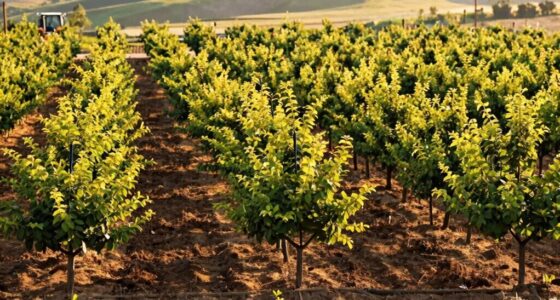
To understand basal area in your small woodlot, you measure each tree’s diameter at breast height, then calculate its cross-sectional area. Adding these areas gives you the total basal area, which shows how crowded or open your stand is. A higher basal area means more competition among trees, while a lower one suggests understocking. Monitoring this measure helps you make better management decisions—stick with us to explore how to apply this in your woodlot.

Get business pricing on tools and workshop supplies
- Business-only prices and quantity discounts
- Tax-exempt purchasing
- Multiple users, one account, clear invoices
Key Takeaways
- Basal area measures the total cross-sectional area of all trees at breast height, indicating stand density.
- Calculated by summing individual tree areas, it helps assess crowding and growth potential in small woodlots.
- Regular monitoring of basal area guides thinning, planting, and management decisions to optimize forest health.
- High basal area suggests overcrowding, potentially reducing growth; low basal area indicates understocked conditions.
- Understanding basal area supports sustainable practices, balancing tree spacing, biomass, and overall productivity.

Understanding basal area is essential for anyone involved in forestry or forest management. It’s a crucial measurement that helps you assess stand density, giving you a clear picture of how crowded your woodland is and how much space each tree occupies. By focusing on basal area, you can make informed decisions about thinning, harvesting, and overall forest health. This measurement considers the cross-sectional area of all trees at breast height, usually expressed in square feet or square meters per acre. It’s a straightforward way to quantify the density of trees in your small woodlot, providing a foundation for effective management practices.
Knowing your stand density through basal area measurements allows you to evaluate growth potential and forest vigor more accurately. As your trees grow, their basal area increases, indicating how much biomass your stand is producing. Monitoring this growth measurement over time helps you identify whether your forest is developing as expected or if it’s becoming too crowded or too sparse. If basal area gets too high, trees may compete for resources like sunlight, water, and nutrients, leading to slower growth rates and potentially weaker trees. Conversely, if it’s too low, your stand might be underutilized, meaning you’re not maximizing your woodlot’s productivity. Regular assessments enable you to strike the right balance, ensuring your forest remains healthy and sustainable.
Applying basal area measurements in the field is straightforward once you get the hang of it. You’ll need a diameter tape or calipers to measure the diameter of each tree at breast height, then calculate each tree’s cross-sectional area. Adding these areas together gives you the total basal area for your stand. This figure can be tracked annually or seasonally, revealing trends in growth and stand density. Armed with this information, you can plan thinning operations to reduce stand density if it’s too high, which promotes better growth for remaining trees. Alternatively, if your basal area indicates understocking, you might consider planting or encouraging natural regeneration to optimize your woodlot’s productivity.
A good understanding of stand dynamics and how basal area reflects these patterns can help you manage your woodlot more effectively over time.
As an affiliate, we earn on qualifying purchases.
Frequently Asked Questions
How Does Basal Area Influence Forest Biodiversity?
You’ll find that basal area directly influences forest biodiversity by shaping habitat complexity and affecting species diversity. A higher basal area often indicates denser stands, which provide more niches for various plants and animals. Conversely, lower basal areas create open spaces that support different species. By managing basal area, you can promote a diverse, resilient ecosystem, supporting a wide range of species and enhancing overall biodiversity in your small woodlot.
Can Basal Area Measurements Predict Timber Quality?
While basal area measurements can give you a general idea of timber quality, they aren’t foolproof for precise predictions. You might think larger basal areas always mean better timber, but factors like species, age, and growth rate also matter. Still, higher basal areas often correlate with increased timber value and can help you estimate growth prediction, making them a useful, though not definitive, tool in evaluating timber quality.
How Often Should Basal Area Be Reassessed in a Small Woodlot?
You should reassess basal area every 3 to 5 years, depending on your stand’s growth rate and density. Regular checks help you monitor changes in stand density, ensuring your woodlot remains healthy and productive. If growth rates are high, more frequent assessments may be necessary to manage thinning or thinning schedules effectively. Keep an eye on these factors to maintain ideal stand structure and timber quality over time.
What Tools Are Best for Measuring Basal Area Accurately?
Think of measuring basal area like catching a snapshot of your forest’s heartbeat. Use a diameter tape or calipers to measure each tree’s diameter at breast height accurately. Then, apply the basal area calculation formula, which involves the tree diameter. A diameter tape is quick and precise for this task, helping you keep your small woodlot’s health in check as easily as reading a map in the woods.
How Does Basal Area Relate to Forest Health Indicators?
You can tell that basal area relates to forest health indicators because higher basal area often signifies dense forest conditions, which impact canopy coverage. When basal area increases, it usually indicates healthy growth but can also suggest overcrowding, leading to competition for resources. Monitoring basal area helps you assess forest density and identify potential issues like pest outbreaks or disease, enabling better management decisions to maintain a healthy, balanced ecosystem.
Conclusion
Understanding basal area helps you manage your small woodlot more effectively, like a miner extracting valuable gems. By measuring it, you gain a clearer picture of your forest’s health and growth potential. Keep track of your trees’ basal areas regularly, just as you’d tend a garden. This simple step turns your woodlot into a well-maintained, thriving space—bright and promising, like a sunrise on a clear morning. Your efforts will reward you with a healthier, more productive woodland.
Fall yard work Picks
leaf blowers
As an affiliate, we earn on qualifying purchases.