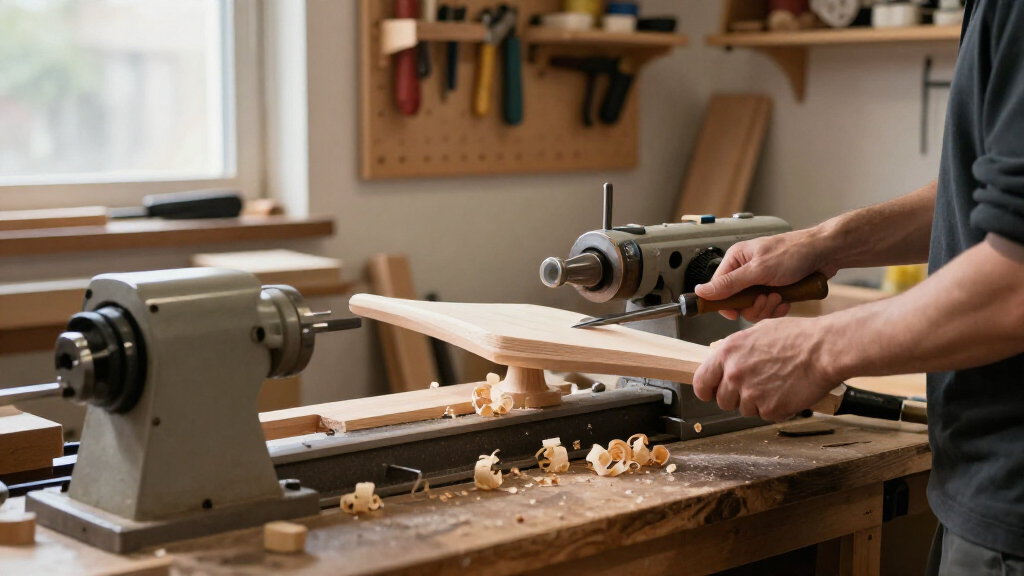
The best wood lathe for most beginners in this roundup is the FinerFurnis 12 x 20-inch benchtop lathe, combining a useful work capacity with four speeds and a digital readout. For smaller projects and a tighter workshop, the VEVOR 8 x 13-inch mini lathe offers variable speed in a compact format, while the VEVOR 1 HP 12 x 18-inch model is the power-focused choice for buyers planning to grow into more demanding work. The main tradeoff is between compact size and room to turn longer or wider pieces; motor power and speed adjustment also affect how forgiving a lathe feels as you learn. I compare all 10 options by beginner usability, capacity, control, and likely workshop fit. Continue reading for the full breakdown and guidance on choosing a first lathe.

Get business pricing on tools and workshop supplies
- Business-only prices and quantity discounts
- Tax-exempt purchasing
- Multiple users, one account, clear invoices
Complete the kit



Key Takeaways
The FinerFurnis 12 x 20-inch model makes the strongest all-around case for a first lathe by pairing moderate capacity with a digital readout and four speed settings.
The two 14 x 40-inch lathes offer much more between-centers capacity than the mini models, but their larger footprint may be unnecessary for a beginner focused on small bowls, pens, or handles.
Variable-speed models such as the Hightall, VEVOR 8 x 13, and VEVOR 1 HP let a learner adjust speed more directly, while four-speed machines call for choosing among preset ranges.
The 96W ONETUON and FesmTek4 mini lathe are geared toward compact, small-scale work; their format should not be mistaken for the capacity of a full benchtop lathe.
Motor power alone does not decide beginner suitability: capacity, speed control, available workspace, and the kinds of projects planned separate the most practical first-lathe choices.

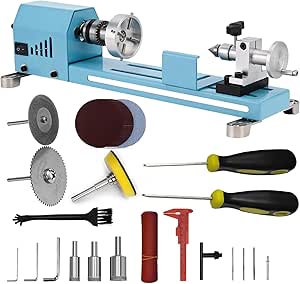


More Details on Our Top Picks
FinerFurnis 12 x 20 in Benchtop Wood Lathe, 400 W (1/2 HP), 4 Speeds, Digital Readout, Blue
For a beginner choosing a first full-size benchtop lathe, the FinerFurnis pairs a 400 W motor with a 12-inch swing and 20-inch workpiece length, a useful mix for learning spindle work and trying modest bowls without taking up the space of a long-bed machine. Its four fixed speeds are less flexible than the Hightall MC813’s variable speed, but the digital readout makes it easier to see the selected RPM and repeat a setting. MT2 tapers also leave room to use compatible accessories as skills grow. The main tradeoff is that speed changes are limited to four steps, and the listed size is inconsistent: the title says 12 x 20 inches while other product information says 14 x 20 inches. I’d choose it over the tiny FesmTek4 when full-size turning matters, but not for frequent large work.
Pros:- 400 W (1/2 HP) motor and 12-inch listed swing suit a wider range of beginner projects than miniature lathes.
- Digital readout shows spindle speed while working.
- Four speed settings cover several common turning tasks.
- MT2 headstock and tailstock tapers support compatible accessories.
Cons:- Four preset speeds offer less fine adjustment than the Hightall MC813’s variable-speed control.
- Product information conflicts on whether the bed size is 12 x 20 or 14 x 20 inches.
- The stated maximum workpiece length limits long spindle projects.
Best for: New woodturners who want a compact benchtop machine for pens, spindles, and smaller bowls, with a speed display and MT2 accessory compatibility.
Not ideal for: Beginners who need continuous speed adjustment or depend on confirmed dimensions before planning a tight workshop layout.
- Swing over bed:12 in
- Maximum workpiece length:20 in
- Motor power:400 W (1/2 HP)
- Speeds:890, 1260, 1760, and 2600 RPM
- Speed display:Digital readout
- Tapers:MT2 headstock and tailstock
- Item weight:44.4 lbs
Our verdict“Choose the FinerFurnis if you want a compact, accessory-compatible first lathe with a clear speed readout and can work within its fixed-speed range.”
FesmTek4 Mini Multi-Purpose Woodworking Lathe
The FesmTek4 is better understood as a small-project hobby tool than as a starter substitute for a full benchtop lathe. Its seven speed settings and stated ability to turn, cut, grind, and polish give a curious beginner several ways to work on compact pieces, while the written instructions and video tutorials may help someone learning basic setup. That range makes it more versatile for small craft tasks than the ONETUON Mini Wood Lathe, whose listed workpiece capacity is specific and limited to 2.76 x 6.3 inches. But the FesmTek4’s 96 W motor and very light 5.68-pound build do not point to larger bowls, long spindles, or heavy cuts. The product information also lists both 96 W motor power and 100 W wattage. I’d pick it for experiments and small projects, not as the main machine for learning traditional woodturning.
Pros:- Seven speed settings provide more adjustment steps than the four-speed FinerFurnis.
- Designed for turning, cutting, grinding, and polishing small projects.
- Includes written instructions and video tutorials.
- Compact 5.68-pound form is easy to move and store.
Cons:- Its 96 W motor and small-project design restrict the size and demands of suitable work.
- Product data lists 96 W motor power and 100 W wattage, which may confuse buyers comparing power.
- Does not provide a stated workpiece capacity in the supplied specifications.
Best for: Beginners focused on tiny craft pieces who want one compact tool for turning, cutting, grinding, and polishing and value included learning materials.
Not ideal for: Woodturners planning bowls, furniture spindles, or other larger work who need a heavier lathe and more motor capacity.
- Model:Fwood03
- Motor power:96 W
- Speed settings:7
- Dimensions:15.5 x 3 x 3 inches
- Item weight:5.68 lbs
- Input voltage:100–240 V; listed voltage 120 V
- Included components:1
Our verdict“Choose the FesmTek4 for varied small craft tasks and included instruction, but select a benchtop lathe like the FinerFurnis for conventional, larger turning projects.”
ONETUON Mini Wood Lathe, 96W, 7 Speeds
Among the miniature options here, the ONETUON makes its limits clearest: it lists a 2.76 x 6.3-inch workpiece capacity and recommends cork, so beginners can match projects to the machine rather than assume it handles ordinary bowl or spindle work. Its aluminum-alloy base and steel headstock are intended to reduce vibration, while four HSS tools and small accessories let a new turner start with more than the bare machine. The stated maximum of 11,000 RPM and seven speed settings offer a very different operating range from the FinerFurnis benchtop lathe, which has a stronger 400 W motor and larger listed capacity. That difference is not a simple upgrade: ONETUON is far lighter and suited to portable, tiny work, but its 96 W power and explicit warning against exceeding rated power make it a poor choice for larger cuts.
Pros:- Clearly stated 2.76 x 6.3-inch workpiece capacity helps set realistic project expectations.
- Includes four HSS tools, an adapter, and basic setup accessories.
- Aluminum-alloy base and steel headstock are designed to limit vibration.
- Light 5.17-pound machine is portable for small DIY work.
Cons:- Recommended material is cork, and the small capacity excludes many common turning projects.
- The 96 W motor is far less powerful than the 400 W FinerFurnis.
- The product description cautions users not to exceed its rated power.
Best for: Portable-workshop hobbyists and beginners who intend to turn cork or similarly small pieces and want included HSS tools.
Not ideal for: Anyone hoping to learn on bowls, long spindles, or larger wood blanks; its stated capacity and 96 W power are restrictive.
- Model:1
- Power:96 W
- Voltage:24 V DC
- Speed settings:7
- Maximum speed:11,000 RPM
- Workpiece capacity:2.76 x 6.3 in
- Weight:5.17 lbs
- Included accessories:4 HSS tools, adapter, power cord, Allen wrench, fixing pins, and polishing sandpaper
Our verdict“Pick the ONETUON for portable cork turning and tiny pieces, not as a general-purpose beginner lathe.”
Hightall 8 x 12-Inch Benchtop Wood Lathe, 1/3 HP, Variable Speed
The Hightall’s standout beginner benefit is its variable speed from 750 to 3,200 RPM: rather than choosing from a few fixed steps, a learner can adjust speed across different woods and stages of a cut. Its cast-iron build and stated low-vibration structure also give it a more substantial benchtop character than the FesmTek4 mini lathe, which is meant for small craft work. The 8 x 12-inch size keeps the Hightall focused on modest bowls, cups, and handles, so it is not a long-bed alternative to the 40-inch 400W model. A spare belt and second tool rest are useful workshop extras, and the manufacturer states a five-year warranty on core components with lifetime support. The tradeoff is its 1/3 HP motor and compact capacity: choose it for control and small projects, not growth into large turning.
Pros:- Variable 750–3,200 RPM range allows finer speed adjustment than the FinerFurnis’s four preset speeds.
- Cast-iron construction and a stated low-vibration design suit steady bench work.
- Includes a spare belt and an additional tool rest.
- Manufacturer states a five-year warranty for core components and lifetime after-sales support.
Cons:- The 8 x 12-inch format is limited to smaller projects.
- Its 1/3 HP motor has less power than the 400 W benchtop options in this lineup.
- The supplied product details do not provide customer review specifics for evaluating owner experience.
Best for: New turners who want a compact, cast-iron benchtop lathe with variable speed for learning how RPM affects small projects.
Not ideal for: Beginners planning long spindles or larger bowls, or those who want the stronger 400 W motor and greater capacity of the 14 x 40-inch model.
- Model:MC813
- Size:8 x 12 inches
- Motor power:1/3 HP; 245 W
- Speed range:750–3,200 RPM
- Tool rest:360-degree rotatable forged tool rest
- Material:Cast iron
- Voltage:110 V
- Item weight:45.4 lbs
- Warranty:5 years for core components; lifetime after-sales support
Our verdict“Choose the Hightall if variable-speed learning and a stable small-project machine matter more than motor power or workpiece size.”
400W Benchtop Wood Lathe, 14″ x 40″, 4-Speed, Blue
This 400 W lathe’s defining advantage is its 40-inch distance between centers, giving a beginner room to attempt long spindles that the 20-inch FinerFurnis cannot accommodate. A 14-inch swing also opens the door to larger-diameter work, while the four speed settings and digital readout provide a straightforward way to select and check RPM. Compared with the Hightall MC813, this model offers much greater stated capacity and a stronger motor, but gives up variable-speed adjustment and the Hightall’s explicitly described cast-iron construction and accessory extras. Its long bed may be more machine than a beginner needs for pens or small handles, and the supplied information warns that assembly may be challenging for newcomers. I’d put it high on the list for someone committed to long-stock turning, but not for a compact first setup.
Pros:- 40-inch distance between centers accommodates long workpieces beyond the FinerFurnis’s 20-inch limit.
- 14-inch cutting diameter gives more capacity for larger bowls and other wide work.
- 400 W motor and four speed settings cover a useful range of beginner projects.
- Digital spindle speed readout helps users check the selected setting.
Cons:- Assembly may be challenging for a beginner.
- Four fixed speeds offer less adjustment than the Hightall’s variable-speed range.
- Long-bed capacity takes more workspace and may be unnecessary for small starter projects.
Best for: Beginners with workshop space who want to learn spindle turning on long stock and need more capacity than a compact 8 x 12 or 12 x 20 lathe.
Not ideal for: Small-project turners with limited bench space, or first-time owners who want simpler setup and continuously adjustable speed.
- Motor power:400 W (3.5 A)
- Voltage:120 V, 60 Hz
- Speed options:1040, 1480, 2130, and 2980 RPM
- Distance between centers:40 in (1000 mm)
- Cutting diameter:14 in (350 mm)
- Workbench lengths available:20, 24, and 40 in
- Item weight:49.2 lbs
- Power source:AC
Our verdict“Choose this model if long spindles and larger workpieces are part of your plan; for compact projects, the Hightall or FinerFurnis is a more proportionate starting point.”
VEVOR 8 x 13 in Mini Benchtop Wood Lathe, 1/3 HP, Variable Speed
For a beginner who wants to learn speed control on small work, this VEVOR pairs a 150–3200 RPM variable-speed range with a compact 8 x 13-inch capacity. The low end can help when roughing, while faster settings suit smaller finishing tasks; unlike the CXRCY 8 x 12-Inch Mini Lathe, it reaches down to 150 RPM rather than starting at 750 RPM. Its cast iron headstock and tailstock, metal bed, and overcurrent protection offer useful safeguards for a first setup, and the included accessory kit helps get initial projects underway. The tradeoff is limited working capacity and a 1/3 HP motor, so this is not the step-up choice for larger blanks. Beginners who want more room and power should compare it with the VEVOR 1/2 HP 14 x 40 in, though that model uses preset speeds.
Pros:- Variable speed from 150 to 3200 RPM supports a range of small turning tasks
- Cast iron headstock and tailstock add mass to the compact machine
- Overcurrent protection is included
- Accessory kit provides a starting point for basic projects
Cons:- 8 x 13-inch capacity limits the size of projects
- 1/3 HP motor is better suited to light work than demanding cuts
- Sheet metal bed is less substantial than a fully cast-iron construction
Best for: New turners focused on small projects who want a broad variable-speed range and basic protection in a benchtop setup
Not ideal for: Beginners planning to turn long or wide workpieces, or who want more motor reserve for heavier cuts
Our verdict“Choose this VEVOR if you want a compact first lathe with wide speed adjustment, but move up to the 1/2 HP VEVOR for larger work.”
VEVOR 1/2 HP Benchtop Wood Lathe, 14 x 40 in, 4 Speeds
Among these beginner options, this VEVOR is the clearest choice for learning on longer stock: its 14 x 40-inch stated capacity gives more room than the mini lathes, including the VEVOR 8 x 13 in. A 1/2 HP motor also offers more power than that smaller model’s 1/3 HP unit. Instead of continuous adjustment, the lathe provides four fixed speeds—930, 1500, 2050, and 2500 RPM—which simplifies selecting a setting but gives less fine control than the variable-speed VEVOR models. Thermal protection adds a useful layer for a learner still developing technique, and the accessory kit lowers the barrier to getting started. Its longer footprint and 49.6-pound weight call for a stable bench and dedicated space. Beginners who value effortless speed changes over capacity may prefer the compact VEVOR or the 1 HP model.
Pros:- 14 x 40-inch stated capacity accommodates longer work than the mini lathes
- 1/2 HP motor offers more power than the 1/3 HP VEVOR mini model
- Four preset speeds cover a range of turning tasks
- Thermal protection and an accessory kit are included
Cons:- Four fixed speeds provide less adjustment than variable-speed models
- 55.91-inch length needs substantial bench space
- 49.6-pound weight makes it less convenient to move or store
Best for: Beginners with a sturdy bench who want to practice on longer pieces and prefer a straightforward set of preset speeds
Not ideal for: Small-shop learners short on bench space or those who want continuous speed adjustment while turning
Our verdict“Pick this model if learning on longer stock matters more than continuous speed control or a compact footprint.”
CXRCY 8 x 12-Inch Mini Benchtop Wood Lathe, 1/3 HP, 750–3200 RPM
The CXRCY makes a practical case for itself through its ready-to-start accessory set: two tool rests, an HSS chisel, a faceplate, centers, and safety goggles cover more initial needs than the basic kit listed with the VEVOR 8 x 13 in Mini Lathe. Its 1/3 HP motor and variable speed suit small projects, while cast-iron construction gives this 44-pound machine more heft than the much lighter ArtyMaster WM101A-Plus. The capacity remains strictly small—12 inches between centers and an 8-inch swing—so it is a training-size lathe, not a route to larger work. Its 750 RPM minimum also gives less low-speed range than the VEVOR mini, which can matter when roughing. Choose it if included tools matter more than extra capacity or low-speed flexibility.
Pros:- Includes two tool rests, an HSS chisel, faceplate, centers, and goggles
- Variable speed from 750 to 3200 RPM accommodates different small tasks
- Cast-iron construction and 44-pound weight provide a substantial base
- 8-inch swing and 12-inch distance between centers suit compact projects
Cons:- Limited to workpieces up to 12 inches long and 8 inches in diameter
- 750 RPM minimum is higher than the VEVOR 8 x 13 in mini’s 150 RPM minimum
- 1/3 HP motor is aimed at light turning
Best for: First-time turners who want a small lathe with several basic tools and safety goggles included
Not ideal for: Buyers who need a low minimum speed, longer work capacity, or a more powerful motor for heavier cuts
Our verdict“Choose the CXRCY if an included starter tool set matters more than larger capacity or a lower minimum speed.”
ArtyMaster WM101A-Plus Mini Wood Lathe
With a 3-inch diameter by 8-inch capacity, the ArtyMaster is a specialized learning tool for pens, rings, and similarly small pieces—not a general-purpose first lathe. Its 17.03-pound weight and compact 16.5-inch length make it far easier to store than the VEVOR 1 HP 12 x 18 in, but that portability comes with a 96W motor that has little headroom for heavier cuts. The package is unusually broad for its scale, including turning tools, a 2-inch chuck, centers, and a drill chuck, so a beginner can explore small turning tasks without assembling every accessory separately. Its adjustable tool rest and variable speed add control, yet the tiny work envelope is a hard limit. Choose the CXRCY instead if you want substantially more capacity and a more substantial motor.
Pros:- Compact 17.03-pound design is easy to store and reposition
- Variable speed and adjustable tool rest provide useful basic control
- Includes turning tools, chuck set, centers, and drill chuck
- Small work capacity suits pens and other miniature projects
Cons:- 3-inch diameter and 8-inch length sharply restrict project size
- 96W motor is not suited to heavier stock or aggressive cuts
- 24V DC power supply adds a separate component to the setup
Best for: Beginners with limited storage who specifically want to make pens, rings, and other small turned items
Not ideal for: Learners hoping to turn bowls or larger blanks, or seeking a machine with power for demanding cuts
Our verdict“Buy the ArtyMaster for a compact introduction to miniature turning, not as a starter lathe for general-sized projects.”
VEVOR 1 HP Benchtop Woodworking Lathe, 12 x 18 in, Variable Speed
This VEVOR is the most powerful option in this group, pairing a 1 HP brushless motor with variable speed from 150 to 3,800 RPM. That reserve can make learning on different small projects less restrictive than with the 1/3 HP VEVOR 8 x 13 in or the 1/2 HP VEVOR 14 x 40 in. Variable speed also avoids choosing among fixed settings, while the cast-iron body and metal handwheels add mass to help limit vibration. Its 12 x 18-inch work area still rules out larger pieces, so the extra power is not a substitute for capacity. At 62.7 pounds, it is also the heaviest machine here and calls for a stable, dedicated bench. This suits beginners ready to invest in power and control for compact turning, rather than those who prioritize portability.
Pros:- 1 HP brushless motor provides more power than the other listed lathes
- Variable speed from 150 to 3800 RPM offers broad control
- Cast-iron body and metal handwheels add substantial construction
- Brushless motor does not require carbon brush replacements
Cons:- 12 x 18-inch work area still limits project size
- 62.7-pound weight makes the lathe difficult to reposition
- More motor capacity may be unnecessary for beginners focused only on miniature work
Best for: Beginners with a sturdy bench who want stronger motor capacity and continuously adjustable speed for small projects
Not ideal for: Buyers who need a lightweight machine, a large work envelope, or a lathe that is easy to move and store
Our verdict“Choose this VEVOR if you want a powerful, variable-speed machine for compact projects and have a stable place to keep it.”
How We Picked
I ranked these wood lathes for beginners by how well their stated capacity, speed controls, and power match realistic first projects. I gave priority to approachable control and useful room to learn, while weighing whether a machine’s size or power might be more than a new turner needs. A digital readout or variable speed can help a beginner make controlled adjustments, but neither feature replaces safe setup and suitable turning tools.
The order reflects overall fit, not raw specifications. Mid-size machines with understandable controls rise when they balance project range with a manageable footprint; compact lathes suit small work but rank lower for versatility, while larger or more powerful models make more sense for specific growth plans. Product details supplied here do not establish factors such as included accessories, support, or construction materials, so I avoid treating those as confirmed advantages.
Factors to Consider When Choosing Wood Lathes For Beginners
Choosing a first lathe is less about buying the most powerful machine and more about matching its capacity and controls to the work you expect to do. These factors can help you avoid paying for unused capacity—or finding that a compact machine limits your next project.
Match Swing and Between-Centers Capacity to Your Projects
Lathe capacity describes the size of work the machine can accommodate: swing relates to the maximum diameter, while distance between centers limits workpiece length. A small mini lathe can suit pens, small handles, and other compact pieces, but it will not offer the same room as a 12 x 20-inch or 14 x 40-inch machine. Beginners often focus on maximum capacity without asking whether their planned projects need it. Measure your usual stock and leave space for safe tool movement rather than choosing based on the biggest number alone. If your projects are uncertain, a middle-sized benchtop option can leave room to learn without committing to the footprint of a long-bed lathe.
Choose Speed Control You Can Learn With
Four-speed machines use preset ranges, while variable-speed lathes let you adjust speed more continuously within their intended operating range. Presets can make initial choices straightforward, though you may need to stop and change settings when moving between different workpieces or operations. Variable speed gives more adjustment at the control, but it does not remove the need to select a safe speed for the blank’s size, balance, and condition. A digital readout can help you see a setting consistently, but a number on a display is only useful when paired with sound technique. New turners should value clear, accessible controls over extra settings they cannot yet use confidently.
Treat Motor Power as One Part of the Match
The listed range here runs from a 96W mini lathe through 1/3 HP and 1/2 HP machines to a 1 HP model. More power may better support demanding work, but it does not make a lathe easier to control or automatically improve beginner results. Small projects may not call for a high-powered machine, while a buyer planning larger or more challenging work may prefer room to grow. The mistake is comparing motor figures without also considering capacity, speed control, and what the machine is designed to turn. Pick power to suit your likely work, then learn safe cutting and speed selection before taking on larger blanks.
Check Workshop Space Before Choosing a Long-Bed Lathe
Compact lathes can be easier to place in a crowded workshop, but a small footprint often comes with more limited capacity. The 14 x 40-inch models in this lineup offer substantial between-centers room, which can be useful for longer work, yet they need space not only for the machine but also for the operator and workpiece handling. Measure the bench, the intended mounting area, and the space needed to stand safely at the lathe. Also think about whether the machine’s weight and mounting needs suit your bench; product listings here do not provide enough information to assume every setup is ready out of the box. A lathe that fits the room and can be set up securely is a better starting point than a larger machine that crowds the work area.
Plan for Tools, Safety Gear, and Setup Separately
A lathe is only one part of a beginner’s turning setup. Turning tools, eye and face protection, workholding accessories, and a stable mounting surface can all affect what projects you can start safely. Do not assume that every listed lathe includes the same accessories; verify the exact package contents before buying. This matters especially for compact and multi-purpose machines, where the working method or compatible tooling may differ from a conventional benchtop lathe. Set aside time to learn blank inspection, tool presentation, and speed selection before turning, and do not treat a machine’s power or display as a safety feature.
Frequently Asked Questions
Should I buy a mini lathe or a full-size benchtop lathe as my first machine?
Choose a mini lathe if you already know your work will stay small and you need a compact machine. A full-size benchtop model gives more room for longer or wider pieces, which can make it a better long-term fit if your interests are still developing. In this lineup, the ONETUON 96W and FesmTek4 are the small-scale options, while machines such as the FinerFurnis and 14 x 40-inch models provide more capacity. Check the workpiece size you expect to turn before choosing by footprint alone. If you are unsure, a mid-size machine may avoid the limits of a mini without requiring a long-bed lathe.
Is variable speed worth choosing over a lathe with four preset speeds?
Variable speed can make it easier to adjust the machine for different operations and workpieces without relying only on preset steps. A four-speed lathe can still be a reasonable first choice if its ranges suit your projects and you are comfortable changing settings as needed. Neither system tells you which speed is safe for an unbalanced or oversized blank, so learning speed selection remains part of using either machine. The Hightall and VEVOR 8 x 13-inch models offer variable speed, while several FinerFurnis and 14 x 40-inch options list four speeds. Give more weight to controls you can use confidently than to the label alone.
Does a higher horsepower rating mean a lathe is better for a beginner?
No. The 1 HP VEVOR offers more stated motor power than the 1/3 HP and 1/2 HP options, but beginners also need suitable capacity, understandable controls, and a safe work area. A stronger motor may make sense if you expect to take on more demanding work as your skills grow, but it does not compensate for poor technique or an unsuitable blank. For small projects, a lower-powered compact machine may be a closer match. Decide what you intend to turn first, then use motor rating as one factor rather than the main buying test.
How much lathe capacity do I need if I have not chosen my first projects yet?
Start by listing a few likely projects and measuring their approximate diameter and length. A mini machine can work for small items, but it leaves less room if you later want to turn longer pieces. A 12 x 20-inch lathe provides a middle ground in this selection, while the 14 x 40-inch models suit buyers who specifically want long between-centers capacity. Larger capacity brings a footprint and setup commitment, so it is not automatically the safer choice for an undecided beginner. If your plans are broad, favor enough capacity for likely growth without buying far beyond your available workspace.
What should I verify before ordering a first wood lathe?
Confirm the exact capacity, speed-control type, motor rating, and power requirements in the current listing, since product names alone may not show every specification. Check what tools and accessories are included rather than assuming the lathe arrives with everything needed for your intended work. Measure your bench and floor space, and confirm that you can mount the machine securely and stand comfortably at it. Look for the manufacturer’s setup, maintenance, and safety instructions before use. These checks help prevent a machine from arriving that is either too limited for your projects or awkward to set up in your workshop.
Conclusion
For the best overall balance, I would start with the FinerFurnis 12 x 20-inch model: its capacity, four speeds, and digital readout make a practical combination for learning. The best compact choice is the VEVOR 8 x 13-inch variable-speed lathe for buyers with limited room and small projects, while the best power-focused premium option is the VEVOR 1 HP 12 x 18-inch model for someone who wants more motor capacity in a shorter format. If value means a straightforward machine with room for longer work, compare the two 14 x 40-inch four-speed lathes against your workshop space before choosing. For a beginner committed to tiny work, the ONETUON or FesmTek4 may fit better than a larger benchtop lathe. Match the machine to your projects and workspace first; extra capacity and power are only useful when you have a plan to use them.
Fall yard work Picks
leaf blowers
As an affiliate, we earn on qualifying purchases.