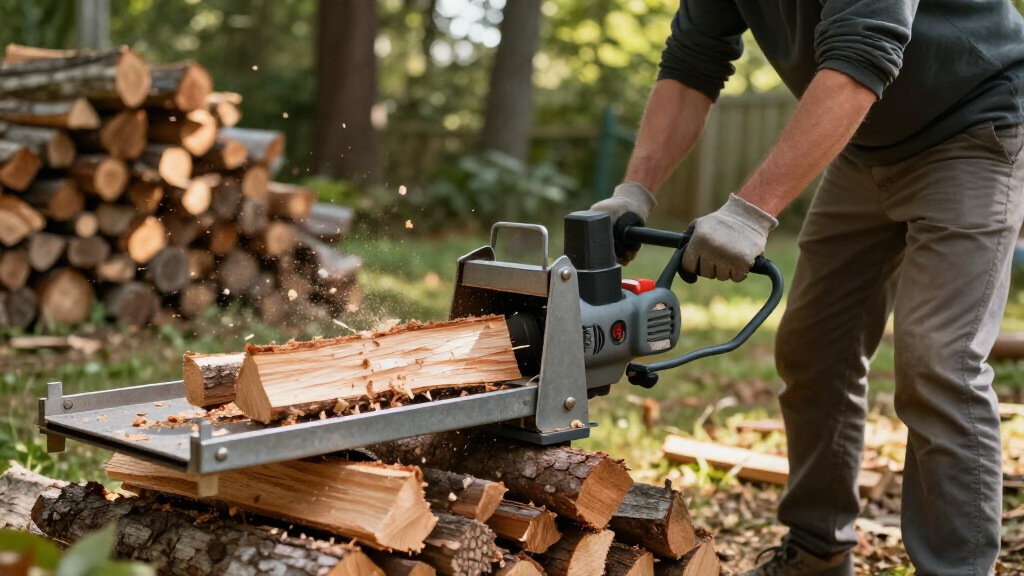

Among the electric log splitters in this roundup, the PPOLB 7 Ton Electric Log Splitter with Detachable Cross Blade is my best overall pick because it combines useful splitting force, compact storage, and a versatile second wedge. The PowerSmart 6.5-Ton is the stronger value choice for routine firewood, while the 16-Ton Brushless Electric Log Splitter offers added muscle for buyers regularly handling larger rounds. The main tradeoffs are force versus portability, low purchase price versus included accessories, and faster multiway splitting versus easier control on irregular wood. Electrical requirements matter too, since the most powerful machine may need more circuit capacity than a typical outdoor outlet provides. Continue reading for the full breakdown and the buyer types each model suits best.

Get business pricing on tools and workshop supplies
- Business-only prices and quantity discounts
- Tax-exempt purchasing
- Multiple users, one account, clear invoices
Complete the kit



Key Takeaways
- Seven-ton models form the lineup’s sweet spot, offering a useful step above basic 6.5-ton machines without the size and electrical demands associated with the 14- and 16-ton options.
- The PPOLB 7 Ton Yellow ranks first because its detachable cross blade adds versatility while its compact format remains practical for a garage, cabin, or backyard.
- PowerSmart’s 6.5-Ton model is the value leader for straight-grained, properly seasoned firewood, but buyers working with knotty hardwood gain more from the heavier models.
- Stands and foot pedals change usability more than small force differences; the Proyama with Stand reduces bending, while the foot-pedal model can make repetitive sessions less awkward.
- The 16-ton model has the highest stated force, but its 17.5-amp motor makes outlet compatibility, extension-cord choice, weight, and storage bigger parts of the buying decision.
| PPOLB 7 Ton Electric Log Splitter with Detachable Cross Blade |  | Best for Four-Way Splitting | Splitting force: 7 tons | Motor current: 15 amps | Motor power: 1,500W | VIEW LATEST PRICE | See Our Full Breakdown |
| PROYAMA 7-Ton Electric Log Splitter with 15A Motor and Cross Wedge |  | Best Flexible Setup | Splitting force: 7 tons | Motor: 15 amps | Listed motor power: 2,700W | VIEW LATEST PRICE | See Our Full Breakdown |
| PowerSmart Electric Log Splitter, 7-Ton with 15 Amp Motor |  | Best Warranty-Backed Home Pick | Splitting force: 7 tons | Motor: 15 amps | Maximum log length: 20 inches | VIEW LATEST PRICE | See Our Full Breakdown |
| 16-Ton Electric Log Splitter with 21 x 16-Inch Capacity |  | Most Powerful | Splitting force: 16 tons | Maximum log length: 21 inches | Maximum log diameter: 16 inches | VIEW LATEST PRICE | See Our Full Breakdown |
| PowerSmart Electric Log Splitter, 6.5-Ton, 15 Amp | | Best for Occasional Firewood | Splitting force: 6.5 tons | Motor: 15 amps | Maximum log length: 20 inches | VIEW LATEST PRICE | See Our Full Breakdown |
| BILT HARD 6.5 Ton Electric Log Splitter with Stand |  | Best Raised Workstation | Splitting Force: 6.5 tons | Maximum Log Diameter: 9.8 inches | Maximum Log Length: 20.5 inches | VIEW LATEST PRICE | See Our Full Breakdown |
| 7-Ton Electric Log Splitter with Upgraded Foot Pedal and 4-Way Cross Wedge |  | Best for Fast Kindling Production | Splitting Force: 7 tons | Motor Power: 3 HP | Hydraulic Pressure: 28 MPa (4000+ PSI) | VIEW LATEST PRICE | See Our Full Breakdown |
| VEVOR 6.5-Ton 1500W Electric Log Splitter |  | Best for Easier Transport | Splitting Force: 6.5 tons | Motor Power: 1500W | Motor Current: 15 amps | VIEW LATEST PRICE | See Our Full Breakdown |
| PPOLB 7 Ton Electric Wood Splitter |  | Best for Wider Rounds | Splitting Force: 7 tons | Motor Power: 1500W | Motor Current: 15 amps | VIEW LATEST PRICE | See Our Full Breakdown |
| Electric Log Splitter 6.5-Ton with 4-Way Wedge |  | Best 4-Way Wedge Alternative | Splitting Force: 6.5 tons | Motor Power: 1500W | Voltage: 120V | VIEW LATEST PRICE | See Our Full Breakdown |
| BILT HARD 6.5 Ton Electric Log Splitter with Hydraulic Ram |  | Best for Small-Diameter Firewood | Motor: 15 Amp | Splitting force: 6.5 tons | Maximum log diameter: 9.8 inches | VIEW LATEST PRICE | See Our Full Breakdown |
| Proyama 7 Ton Log Splitter with Stand |  | Best Elevated Workstation | Splitting force: 7 tons | Motor power: 2.7 kW | Maximum log diameter: 10 inches | VIEW LATEST PRICE | See Our Full Breakdown |
| BILT HARD 14 Ton Electric Log Splitter with 15 Amp Hydraulic Pump |  | Best for Hardwood | Splitting force: 14 tons | Motor: 15 Amp, 1800 W | Voltage: 120 V | VIEW LATEST PRICE | See Our Full Breakdown |
| electric log splitter | Splitting force | Maximum log diameter | Maximum log length | Weight |
|---|---|---|---|---|
| PPOLB 7 Ton Electric Log Split | 7 tons | — | — | 112.4 pounds |
| PROYAMA 7-Ton Electric Log Spl | 7 tons | 10 inches | 20.5 inches | 110 pounds |
| PowerSmart Electric Log Splitt | 7 tons | 10 inches | 20 inches | 101 pounds |
| 16-Ton Electric Log Splitter w | 16 tons | 16 inches | 21 inches | — |
| PowerSmart Electric Log Splitt | 6.5 tons | 10 inches | 20 inches | — |
| BILT HARD 6.5 Ton Electric Log | 6.5 tons | 9.8 inches | 20.5 inches | 114.6 pounds |
| 7-Ton Electric Log Splitter wi | 7 tons | — | — | 95 pounds |
| VEVOR 6.5-Ton 1500W Electric L | 6.5 tons | 9.8 inches | 20 inches | 99.2 pounds |
| PPOLB 7 Ton Electric Wood Spli | 7 tons | 12 inches | 21.2 inches | 108 pounds |
| Electric Log Splitter 6.5-Ton | 6.5 tons | 9.8 inches | 20.5 inches | 110 pounds |
| BILT HARD 6.5 Ton Electric Log | 6.5 tons | 9.8 inches | 20.5 inches | 98 pounds |
| Proyama 7 Ton Log Splitter wit | 7 tons | 10 inches | 20.5 inches | — |
| BILT HARD 14 Ton Electric Log | 14 tons | 16 inches | 20 inches | — |
More Details on Our Top Picks
PPOLB 7 Ton Electric Log Splitter with Detachable Cross Blade
I place the PPOLB 7 Ton Electric Log Splitter in the four-way role because its detachable cross blade can turn one ram stroke into smaller firewood pieces, a practical advantage over the PowerSmart 7-Ton’s standard setup. Its 15-amp, 1,500-watt motor and seven-ton hydraulic force fit routine oak and maple work without gas fumes, while wheels make garage-to-yard movement possible. The catch is that its 112.4-pound weight makes “portable” relative, and seven tons still leaves oversized or heavily knotted rounds outside its comfort zone. Buyer feedback also points to only moderate durability, so I rank it below higher-confidence choices for frequent workloads. This pick makes sense when faster kindling-size output matters more than low weight or maximum force.
Pros:- Detachable cross blade produces smaller pieces per stroke
- Seven-ton hydraulic force can handle routine oak and maple splitting
- Electric motor runs without fuel or exhaust fumes
- Transport wheels help move the machine between storage and work areas
Cons:- At 112.4 pounds, moving it over steps or uneven ground may be difficult
- Seven-ton force is insufficient for many oversized or stubborn rounds
- Buyer feedback suggests only moderate long-term durability
Best for: Homeowners who want to split manageable hardwood rounds into four smaller firewood pieces with fewer repeated strokes
Not ideal for: High-volume users or anyone handling oversized, heavily knotted logs that may exceed seven tons of force
- Splitting force:7 tons
- Motor current:15 amps
- Motor power:1,500W
- Cutter:Detachable cross blade
- Length:39.37 inches
- Width:19.29 inches
- Height:11.61 inches
- Weight:112.4 pounds
Our verdict“I recommend this PPOLB model for homeowners who value four-way splitting more than easy lifting or heavy-duty capacity.”
PROYAMA 7-Ton Electric Log Splitter with 15A Motor and Cross Wedge
I give the PROYAMA 7-Ton Electric Log Splitter the flexible-setup spot because it can work with or without a stand and has adjustable, never-flat wheels. That makes it easier to tailor the working height than the low-profile PPOLB 7 Ton, while its cross wedge offers similar multi-piece splitting appeal. The listed 2,700-watt motor is powerful for this class, though the machine still accepts logs only up to 10 inches across and 20.5 inches long. Its two-hand controls help keep hands away from the splitting area, but they also prevent true one-handed operation. At 110 pounds, this is transportable rather than lightweight, and the lack of stated cord length leaves buyers to confirm whether an outdoor-rated extension setup will be needed.
Pros:- Can be operated with or without a stand
- Cross wedge can create smaller firewood pieces per cycle
- Two-hand controls keep both hands away from the splitting zone
- Adjustable 5.5-inch never-flat wheels simplify repositioning
Cons:- The 110-pound body remains difficult to move across rough terrain
- Maximum log diameter is limited to 10 inches
- Cord length and onboard cord storage are not stated
Best for: Homeowners who want a selectable working height, cross-wedge splitting, and two-hand operation for regular residential firewood preparation
Not ideal for: Buyers who need one-handed controls, easy stair transport, or capacity for rounds wider than 10 inches
- Splitting force:7 tons
- Motor:15 amps
- Listed motor power:2,700W
- Maximum log diameter:10 inches
- Maximum log length:20.5 inches
- Weight:110 pounds
- Package dimensions:38.19 x 20.87 x 11.81 inches
- Wheels:5.5-inch never-flat wheels
- Safety controls:Two-hand operation
Our verdict“I favor the PROYAMA for residential buyers who want adjustable ergonomics and a cross wedge within a seven-ton machine.”
PowerSmart Electric Log Splitter, 7-Ton with 15 Amp Motor
I rank the PowerSmart 7-Ton Electric Log Splitter as the warranty-backed home pick because its two-year warranty adds purchase protection that is not stated for the PPOLB 7 Ton or PROYAMA 7-Ton. It handles the familiar residential limit of 20-inch-long, 10-inch-wide logs, yet supplies half a ton more force than the PowerSmart 6.5-Ton. That extra margin can help with moderately stubborn rounds, although it does not make this a commercial machine. A 20-second cycle supports steady small-batch work, and the 101-pound weight is lower than the PPOLB and PROYAMA models in this batch. Still, it remains heavy enough to dislike stairs, while the 3.9-out-of-5 buyer rating signals mixed satisfaction. I see it as a sensible middle ground for occasional home firewood, not sustained high-volume splitting.
Pros:- Seven-ton force offers more headroom than the PowerSmart 6.5-Ton
- Two-year warranty provides defined coverage
- Twenty-second cycle supports steady residential work
- At 101 pounds, it is lighter than several seven-ton alternatives in this batch
Cons:- Built primarily for occasional, light-duty use
- Log capacity stops at 20 inches long and 10 inches wide
- The 3.9-out-of-5 customer rating reflects mixed owner satisfaction
Best for: Homeowners splitting modest batches of logs who want seven-ton force paired with a stated two-year warranty
Not ideal for: Commercial operators, frequent wood sellers, or households regularly processing rounds beyond 20 by 10 inches
- Splitting force:7 tons
- Motor:15 amps
- Maximum log length:20 inches
- Maximum log diameter:10 inches
- Cycle time:20 seconds
- Dimensions:37.4 x 10.6 x 18.49 inches
- Weight:101 pounds
- Warranty:2 years
Our verdict“I would choose this model for occasional home splitting when warranty coverage matters more than commercial-grade output.”
16-Ton Electric Log Splitter with 21 x 16-Inch Capacity
I assign this 16-Ton Electric Log Splitter the power lead because it exceeds even the BILT HARD 14 Ton and more than doubles the force of the seven-ton machines here. Its 21-by-16-inch log capacity gives owners of larger hardwood rounds far more room than the 10-inch-diameter limit on both PowerSmart models. An 18-second cycle also beats their 20-second pace, while the brushless motor and 65 dB rating suit work around homes or enclosed, ventilated utility areas. That capability brings compromises: the 47.2-inch frame needs more storage room, its weight is not disclosed, and the 17.5-amp motor demands more electrical headroom than common 15-amp models. I rank it highest for difficult residential wood, but its stated light-commercial scope stops short of an industrial recommendation.
Pros:- Sixteen-ton force leads every model named in the roundup
- Handles rounds up to 21 inches long and 16 inches wide
- Eighteen-second cycle is faster than the listed PowerSmart models
- Brushless motor and 65 dB rating support quieter operation
Cons:- 17.5-amp draw requires more electrical capacity than 15-amp alternatives
- Large 47.2-inch frame takes more storage space
- Missing weight data makes transport difficulty hard to judge
Best for: Homeowners and light-commercial users processing larger hardwood rounds that overwhelm typical 6.5- or 7-ton electric splitters
Not ideal for: Buyers with limited storage, unknown circuit capacity, or industrial workloads that demand continuous production
- Splitting force:16 tons
- Maximum log length:21 inches
- Maximum log diameter:16 inches
- Motor current:17.5 amps
- Motor power:1,600W
- Motor type:Brushless induction
- Cycle time:18 seconds
- Dimensions:47.2 x 17.3 x 33.8 inches
- Noise rating:65 dB
Our verdict“I recommend this model when large-round capacity and splitting force outweigh compact storage and standard 15-amp convenience.”
PowerSmart Electric Log Splitter, 6.5-Ton, 15 Amp
I choose the PowerSmart 6.5-Ton Electric Log Splitter for occasional firewood because it keeps the familiar 20-by-10-inch capacity and 20-second cycle without pretending to be a heavy-duty machine. Compared with the PowerSmart 7-Ton, it gives up half a ton of force while retaining the same stated log limits and two-year warranty. That makes it the more narrowly focused option for straight-grained, properly sized rounds rather than knot-heavy hardwood. Wheels and a handle support movement around a garage or level yard, and its 37.4-inch length is manageable for residential storage. The tradeoff is limited reserve power: difficult pieces may require trimming or another splitter. I place it behind the seven-ton model for versatility, but its simple light-duty remit suits buyers who prepare small seasonal batches.
Pros:- Twenty-second cycle is suitable for modest home batches
- Wheels and a handle help with movement on level surfaces
- Two-year warranty matches the seven-ton PowerSmart model
- Compact horizontal dimensions fit residential storage areas
Cons:- Lower force leaves less reserve for dense or knotted wood
- Restricted to logs up to 20 inches long and 10 inches wide
- Not designed for commercial or sustained heavy-duty work
Best for: Households preparing small seasonal batches of straight-grained logs no larger than 20 inches by 10 inches
Not ideal for: Frequent users and hardwood burners who regularly encounter knotty, oversized, or high-volume loads
- Splitting force:6.5 tons
- Motor:15 amps
- Maximum log length:20 inches
- Maximum log diameter:10 inches
- Cycle time:20 seconds
- Dimensions:37.4 x 10.6 x 18.1 inches
- Construction:Steel
- Warranty:2 years
Our verdict“I recommend the 6.5-ton PowerSmart for small seasonal firewood jobs where compact storage matters more than extra splitting force.”
BILT HARD 6.5 Ton Electric Log Splitter with Stand
I rank the BILT HARD 6.5 Ton Electric Log Splitter with Stand as the best raised workstation because its adjustable stand reduces the bending required when processing a firewood pile. Its 6.5-ton ram and 20.5-inch bed suit routine residential splitting, while the wheeled base helps reposition the machine between a garage and work area.
Compared with the VEVOR 6.5-Ton Splitter, this BILT HARD model offers a more comfortable working height but weighs over 15 pounds more. That makes it steadier during operation yet harder to load into a vehicle or carry over steps. The 9.8-inch diameter limit also puts it behind the PPOLB 7 Ton model for wider rounds. I would choose it for posture and stability, not maximum capacity or easy lifting.
Pros:- Adjustable stand reduces repeated bending
- 6.5-ton hydraulic force suits routine residential firewood
- Wheels make ground-level repositioning manageable
- 20.5-inch bed accepts common stove-length logs
Cons:- At 114.6 pounds, it is the heaviest model in this five-product batch
- 9.8-inch diameter capacity excludes larger rounds
- 15-amp motor requires careful outlet and extension-cord selection
Best for: Homeowners who split standard-size firewood regularly and want a raised, adjustable working position
Not ideal for: Buyers who must lift the splitter into a vehicle or process rounds wider than 9.8 inches
- Splitting Force:6.5 tons
- Maximum Log Diameter:9.8 inches
- Maximum Log Length:20.5 inches
- Motor Current:15 amps
- Voltage:120V
- Weight:114.6 pounds
- Package Dimensions:37.8 x 20.87 x 11.02 inches
- Stand:Adjustable
Our verdict“This is my pick for buyers who value a raised working height more than low weight or wide-log capacity.”
7-Ton Electric Log Splitter with Upgraded Foot Pedal and 4-Way Cross Wedge
This 7-Ton Electric Log Splitter earns its place through a combination none of the other four matches: a foot pedal, 22-inch bed, and included 4-way wedge. The longer bed accepts firewood that would exceed the VEVOR model’s 20-inch limit, while the cross wedge can turn suitable straight-grained rounds into several smaller pieces per stroke.
I place it ahead of the 6.5-Ton 4-Way Wedge model for versatility because it adds more splitting force and a longer working bed at a lower listed weight. The compromise is its 18-second cycle, which can feel slow when every round needs several passes. A multi-way wedge may also struggle with knotty or irregular wood, so the standard wedge remains the better choice there. The foot control is convenient, but buyers should follow the supplied operating procedure closely.
Pros:- Included standard and 4-way wedges support different splitting jobs
- 22-inch bed is the longest among these five models
- 7-ton force provides more headroom than the 6.5-ton options
- Foot pedal can simplify repetitive operation
Cons:- 18-second cycle limits throughput on large piles
- 95-pound weight still makes lifting awkward
- The 4-way wedge is less suitable for knotty or irregular rounds
Best for: Firewood users who frequently make kindling or smaller stove pieces from straight-grained logs up to 22 inches long
Not ideal for: High-volume operators who prioritize a short cycle or buyers mainly splitting twisted, knot-heavy rounds
- Splitting Force:7 tons
- Motor Power:3 HP
- Hydraulic Pressure:28 MPa (4000+ PSI)
- Maximum Splitting Length:22 inches
- Cycle Time:18 seconds
- Weight:95 pounds
- Dimensions:32 x 15 x 21 inches
- Included Wedges:Standard wedge and 4-way cross wedge
Our verdict“I recommend this model to buyers who want long-log capacity and rapid kindling production in one package.”
VEVOR 6.5-Ton 1500W Electric Log Splitter
I give the VEVOR 6.5-Ton Electric Log Splitter the mobility role because its 99.2-pound frame and 6-inch wheels are easier to manage than the 114.6-pound BILT HARD with stand or the 110-pound 4-way-wedge model. Its 1500W motor and 6.5-ton ram cover ordinary backyard firewood without fuel, exhaust, or engine maintenance.
That portability does not make it genuinely lightweight, and it still needs a suitable outlet near the work area. Compared with the PPOLB 7 Ton splitter, the VEVOR gives up force, log length, and diameter capacity; its 9.8-inch by 20-inch limit is aimed at already manageable rounds. Two-hand operation supports deliberate control but prevents one hand from steadying wood during the stroke. I see it as a practical choice for moving between storage and a nearby splitting spot, not for oversized hardwood.
Pros:- 6-inch wheels aid movement across firm, level ground
- Lighter than three of the other models in this batch
- 1500W electric motor avoids fuel storage and exhaust
- Two-hand controls discourage hands from approaching the wedge
Cons:- 9.8-inch diameter and 20-inch length limits are restrictive
- Still heavy enough to make stairs and vehicle loading difficult
- Performance can suffer with an undersized or overly long extension cord
Best for: Homeowners who move their splitter between a garage and nearby yard and mainly handle pre-cut, moderate-size rounds
Not ideal for: Cabin owners working far from power or anyone regularly splitting logs wider than 9.8 inches
- Splitting Force:6.5 tons
- Motor Power:1500W
- Motor Current:15 amps
- Maximum Log Diameter:9.8 inches
- Maximum Log Length:20 inches
- Transport Wheels:6 inches
- Weight:99.2 pounds
- Dimensions:37.4 x 10.83 x 18.19 inches
Our verdict“This is my mobility-focused choice for moderate residential logs kept within reach of a suitable electrical outlet.”
PPOLB 7 Ton Electric Wood Splitter
The PPOLB 7 Ton Electric Wood Splitter leads this group for round capacity, pairing 7 tons of force with a 12-inch diameter limit. That extra width matters when oak or maple pieces are too broad for the 9.8-inch limits shared by the BILT HARD, VEVOR, and 6.5-ton 4-way-wedge models. Its 21.2-inch bed also provides more length than those three machines.
I rank it below the unnamed 7-Ton model with the 22-inch bed for accessory versatility because the supplied data lists no foot pedal or 4-way wedge. At 108 pounds, it also asks more of anyone loading it into a cabin-bound vehicle, despite having transport wheels for movement on level ground. The steel construction favors durability over easy lifting, and the 15-amp electric drive ties the work site to an outlet. I would pick it when log diameter matters more than accessories or minimum weight.
Pros:- 12-inch log diameter capacity is the widest in this batch
- 7-ton force offers more splitting headroom than 6.5-ton models
- 21.2-inch bed accommodates common full-length firewood
- Steel construction and transport wheels balance durability with ground mobility
Cons:- 108-pound build is difficult to lift or load alone
- No cross wedge or raised stand is listed
- Outlet dependence limits use at remote woodpiles
Best for: Homeowners splitting wider oak or maple rounds that exceed the common 9.8-inch capacity of compact electric models
Not ideal for: Buyers who need to carry a splitter up steps, work beyond extension-cord reach, or want an included cross wedge
- Splitting Force:7 tons
- Motor Power:1500W
- Motor Current:15 amps
- Maximum Log Length:21.2 inches
- Maximum Log Diameter:12 inches
- Weight:108 pounds
- Dimensions:39.37 x 19.29 x 11.61 inches
Our verdict“I would choose the PPOLB when wider-round capacity matters more than low weight or bundled splitting accessories.”
Electric Log Splitter 6.5-Ton with 4-Way Wedge
This 6.5-Ton Electric Log Splitter fills a narrow role for buyers who want an included 4-way wedge but do not need the 22-inch bed or 7-ton output of the foot-pedal model. Splitting suitable straight-grained rounds into multiple pieces per stroke can reduce repositioning, while the two-hand control keeps the operating position deliberate.
I rank it behind the 7-Ton model with the upgraded foot pedal because both list an 18-second cycle, yet this machine is heavier at 110 pounds and accepts shorter, narrower logs. Its 20.5-inch length and 9.8-inch diameter limits are adequate for prepared residential firewood, not large raw rounds. The listed 3-out-of-5 customer rating adds purchase risk compared with a more established choice, and the cross wedge will not suit every grain pattern. I would buy it only when the bundled wedge and conventional two-hand layout are the deciding factors.
Pros:- Included 4-way wedge can reduce passes on cooperative wood
- Two-hand control keeps both hands away from the splitting area
- 1500W motor provides emission-free operation at the work site
- Heavy-duty steel build supports stable horizontal splitting
Cons:- Listed 3-out-of-5 customer rating suggests uneven owner satisfaction
- 110-pound weight undermines its portable positioning
- Lower force and smaller capacity than the 7-ton foot-pedal model
Best for: Occasional residential users who want a bundled 4-way wedge for straight-grained firewood and prefer two-hand controls
Not ideal for: Buyers seeking proven owner satisfaction, easy vehicle loading, or capacity for rounds wider than 9.8 inches
- Splitting Force:6.5 tons
- Motor Power:1500W
- Voltage:120V
- Motor Current:15 amps
- Cycle Time:18 seconds
- Maximum Log Diameter:9.8 inches
- Maximum Log Length:20.5 inches
- Weight:110 pounds
- Dimensions:39 x 18 x 11 inches
Our verdict“This model makes sense to me only for buyers who prioritize an included cross wedge and two-hand operation over higher capacity and stronger buyer feedback.”
BILT HARD 6.5 Ton Electric Log Splitter with Hydraulic Ram
I place the BILT HARD 6.5 Ton Electric Log Splitter in the small-log role because its narrow 9.8-inch diameter limit defines both its appeal and its main weakness. The 15-amp motor and 6.5 tons of force suit routine splitting of straight-grained firewood, while the 98-pound build and transport wheels make relocation easier than with the 118.8-pound Proyama 7 Ton. Its 18-second cycle is adequate for occasional batches, though frequent users may find the pace restrictive. Compared with the BILT HARD 14 Ton, this model is easier to store but far less capable with thick hardwood rounds. I also favor its two-hand controls for deliberate operation, yet the required electrical setup and 90-day warranty weaken its value for buyers expecting intensive, long-term service.
Pros:- 6.5 tons of force suits routine residential firewood preparation
- At 98 pounds, it is lighter than the Proyama 7 Ton
- Transport wheels help with movement around a yard or garage
- Two-hand controls reduce accidental activation
Cons:- The 9.8-inch log-diameter ceiling excludes many larger rounds
- An appropriate extension cord and circuit setup may add cost and complexity
- The 90-day warranty is short for hydraulic equipment
Best for: Homeowners splitting occasional batches of straight-grained logs under 9.8 inches in diameter near a household power outlet
Not ideal for: Buyers processing thick hardwood rounds or relying on the machine frequently, given its modest capacity and short warranty
- Motor:15 Amp
- Splitting force:6.5 tons
- Maximum log diameter:9.8 inches
- Maximum log length:20.5 inches
- Cycle time:18 seconds
- Weight:98 pounds
- Dimensions:36.4 x 10.4 x 18.3 inches
Our verdict“I recommend this model for occasional small-log work, but buyers handling thick or stubborn hardwood should move up to the BILT HARD 14 Ton.”
Proyama 7 Ton Log Splitter with Stand
The Proyama 7 Ton Log Splitter earns this role because its heavy-duty stand raises the working area and reduces the repeated bending associated with low horizontal splitters. That setup makes more sense for longer sessions than the ground-level BILT HARD 6.5 Ton, while the 7-ton force provides a modest performance step up. Its 45-degree wedge is shaped for decisive splitting, and adjustable wheels plus handles help reposition the assembled unit. The compromise is bulk: at 118.8 pounds, it is harder to load, lift, or move across rough ground than the lighter BILT HARD. Its 10-inch diameter limit also leaves it far behind the BILT HARD 14 Ton for large hardwood rounds. I rank it for working-height convenience, not maximum capacity or compact storage.
Pros:- Included heavy-duty stand provides a more comfortable working height
- Seven tons of force offers a small capacity advantage over 6.5-ton models
- Adjustable wheels and handles support repositioning around a work area
- The 45-degree wedge is designed for efficient penetration
Cons:- The 118.8-pound weight may require two people for lifting or loading
- The 10-inch diameter capacity is restrictive for larger firewood rounds
- Available product data does not specify cord length or onboard storage
Best for: Frequent residential users who want an elevated splitting position for repeated batches of logs no wider than 10 inches
Not ideal for: Solo users who must lift the splitter into a vehicle or anyone regularly processing rounds wider than 10 inches
- Splitting force:7 tons
- Motor power:2.7 kW
- Maximum log diameter:10 inches
- Maximum log length:20.5 inches
- Wedge angle:45 degrees
- Item weight:118.8 pounds
- Package dimensions:37.2 x 20.4 x 13.2 inches
Our verdict“I would choose the Proyama for stand-mounted convenience during regular small-log sessions, not for portability or oversized rounds.”
BILT HARD 14 Ton Electric Log Splitter with 15 Amp Hydraulic Pump
I rank the BILT HARD 14 Ton Electric Log Splitter highest for demanding wood because it doubles the force of the Proyama 7 Ton while accepting rounds up to 16 inches in diameter. That wider capacity matters when knotty hardwood or seasoned firewood would overwhelm smaller residential machines. The two-stage hydraulic pump is intended to balance speed and force, and the 10-inch wheels make movement around a property more manageable. It still runs from a standard 120-volt supply, avoiding the fuel storage and exhaust of a gas splitter. Buyers give up some flexibility, however: logs longer than 20 inches will not fit, and outlet access remains mandatory. Compared with the BILT HARD 6.5 Ton, this is the stronger choice for serious batches, but its hydraulic noise and larger system may be excessive for light seasonal use.
Pros:- Fourteen tons of force handles tougher wood than the 6.5- and 7-ton alternatives
- Sixteen-inch diameter capacity accommodates substantially larger rounds
- Two-stage hydraulic pump pairs high force with smoother operation
- Two-hand operation and overload protection support safer use
Cons:- The 20-inch length limit excludes longer stove-length rounds
- Dependence on 120-volt power restricts use away from outlets
- Hydraulic operation may be too noisy or elaborate for occasional light work
Best for: Homeowners and small-property users who regularly split seasoned hardwood rounds up to 16 inches wide near 120-volt power
Not ideal for: Occasional users handling small softwood pieces or anyone who needs off-grid operation and capacity beyond 20-inch logs
- Splitting force:14 tons
- Motor:15 Amp, 1800 W
- Voltage:120 V
- Maximum log diameter:16 inches
- Maximum log length:20 inches
- Hydraulic pump:Two-stage
- Hydraulic oil reservoir:1.45 gallons
- Transport wheels:10 inches
Our verdict“I recommend this model for buyers who need electric convenience without giving up the force required for thick, seasoned hardwood.”
How We Picked
I ranked these electric log splitters by how well their specifications address real firewood jobs rather than by tonnage alone. My main criteria were rated splitting force, stated log capacity, motor demand, wedge configuration, operating height, portability, and the likely usefulness of included stands or cross wedges. I gave extra weight to machines that balance everyday capability with manageable storage, since many buyers will move a splitter between a garage, yard, and woodpile. I also compared products within their closest groups: 6.5-ton compact models, 7-ton general-purpose machines, and higher-force 14- or 16-ton splitters.
The ranking favors the PPOLB 7 Ton Yellow because it provides the most balanced package, while the 6.5-ton PowerSmart earns its value role through a simpler, lower-cost approach. The 16-ton brushless model ranks as the premium choice for demanding wood, though its 17.5-amp electrical requirement and larger format narrow its audience. Stands, foot controls, and four-way wedges earned credit only when they improved a specific job; they did not automatically outweigh circuit compatibility, controlled splitting, or portability. Because actual performance varies with species, moisture, grain, knots, and log shape, I treated manufacturer tonnage as a comparison point rather than a guarantee for every round.
Factors to Consider When Choosing Electric Log Splitters
I would choose an electric splitter by matching the machine to the hardest wood, longest work session, and outlet available at the splitting site. The highest force rating is not automatically the best purchase, since extra capacity can bring more weight, higher current draw, and a less convenient setup. The factors below help separate a practical daily tool from a machine that looks capable on paper but does not fit the buyer’s workflow.
Match Splitting Force to Wood, Not Marketing
A 6.5- or 7-ton splitter usually makes the most sense for seasoned, straight-grained fireplace wood cut within the machine’s stated dimensions. Green hardwood, twisted grain, crotches, and dense knots can demand far more force than a round’s diameter suggests. Buyers who regularly process that material may prefer a 14- or 16-ton model, even if most logs are modest in size. Rated tonnage does not reveal cycle speed, wedge geometry, or how the machine behaves when a log resists the first attempt. I would avoid buying solely around the largest log handled once a year; renting a gas splitter for rare oversized rounds can be cheaper and easier. For routine work, the better target is enough reserve force to handle the toughest common logs without paying for capacity that sits unused.
Check the Entire Electrical Path
Most models here use a 15-amp motor, which can place a substantial load on a standard household circuit during startup or a hard split. A 17.5-amp machine deserves even closer attention because the outlet, breaker, wiring, and manufacturer instructions must all support its demand. Sharing the circuit with freezers, heaters, or workshop tools can lead to nuisance trips. Long, undersized extension cords create voltage drop and heat, so I would favor a short outdoor-rated cord with the gauge specified in the manual. The splitter should connect through appropriate ground-fault protection when used outside or around damp ground. Checking the motor nameplate and manual before purchase can prevent an expensive machine from being unusable at the woodpile.
Choose Between a Flat Chassis and a Stand
Low horizontal splitters are compact, stable, and easier to store, but they can require repeated bending or a separate work platform. A model with a purpose-built stand, such as the Proyama or BILT HARD stand configurations, places the work closer to waist height. That difference becomes more meaningful during a long cordwood session than a half-ton increase in rated force. The drawback is a larger storage footprint and a higher lift when loading heavy rounds. A homemade table must support the machine securely without blocking controls, wheels, or ventilation. I would prioritize comfortable operating height for frequent batches and choose a low chassis when compact storage and easy transport matter more.
Decide Whether a Four-Way Wedge Fits the Job
A four-way or cross wedge can create several pieces in one ram stroke, making it appealing for straight, uniform rounds. It can also demand more force because the machine is opening multiple grain paths at once. On crooked or knotty logs, a single wedge gives the operator more control over placement and may stall less often. Detachable designs offer the better compromise because the extra wedge can be removed when the wood becomes difficult. Buyers seeking small kindling may still need another pass, since a four-way split does not guarantee uniformly thin pieces. I view a cross wedge as a speed accessory for suitable wood, not a substitute for higher hydraulic capability.
Account for Cycle Time, Handling, and Storage
Tonnage draws attention, but cycle time shapes productivity across dozens of logs. A slower machine may still suit occasional fireplace use, while frequent processing rewards a quick return stroke and an efficient staging area. Wheels help on firm pavement yet may struggle in mud, gravel, or wood chips, especially when fitted to a heavier high-force model. Measure the path from storage to the splitting site, including thresholds, slopes, and tight turns. A compact machine can save more effort across a season than a powerful unit that is awkward to deploy. I would also leave room for hydraulic inspection and cleaning rather than storing the splitter where every service point is blocked.
Frequently Asked Questions
Is a 6.5-ton or 7-ton electric log splitter powerful enough for hardwood?
A 6.5- or 7-ton machine can split many seasoned hardwood rounds when the grain is fairly straight and the diameter stays within the stated capacity. Species alone does not settle the question: knots, crotches, moisture, and twisted grain often matter more than the label hardwood. The 7-ton PPOLB and PROYAMA models provide a little more reserve than their 6.5-ton rivals, but that difference will not turn every stubborn round into an easy split. Buyers who routinely encounter dense, irregular pieces should move toward the BILT HARD 14 Ton or 16-Ton model. For occasional difficult logs, quartering with another method or renting a stronger splitter may make more financial sense.
Do I need a dedicated circuit for an electric log splitter?
A dedicated circuit is often the safer practical choice for a 15-amp splitter, especially when the motor works near full load. The correct answer depends on the machine’s manual, motor plate, breaker rating, wiring, and other devices using the circuit. The 16-ton model’s stated 17.5-amp motor calls for extra scrutiny and should not be assumed compatible with every common receptacle. Avoid solving repeated breaker trips with a larger breaker unless a qualified electrician has verified the wiring and load. I would confirm the required voltage, amperage, protection, and extension-cord gauge before ordering.
Is a four-way wedge better than a standard wedge?
A four-way wedge is better when the goal is higher output from straight, uniform rounds. It creates more resistance, however, and can be frustrating on knotty pieces that would split cleanly with one carefully placed wedge. That makes the detachable cross blades on the PPOLB and PROYAMA models more flexible than a permanently fixed configuration. I would use the cross wedge for predictable firewood and remove it for difficult grain. Buyers who value precise split size over raw speed may prefer a standard wedge alone.
Should I buy an electric log splitter with a stand?
A stand is worthwhile for buyers who process enough wood that repeated bending causes fatigue. The Proyama 7 Ton with Stand and BILT HARD 6.5 Ton with Stand offer a more natural working height than low compact units. Their tradeoff is extra bulk, and lifting heavy rounds higher can offset some of the comfort benefit. A low model is easier to store under shelving or move into a vehicle, while a stand model better suits a fixed work area. I would choose based on session length, log weight, and storage space, not appearance.
When is a 14- or 16-ton electric splitter worth the extra cost?
The upgrade makes sense when tough hardwood, larger diameters, or irregular grain forms a regular part of the workload. Higher force reduces the number of logs set aside for another machine, but it may bring added weight, slower repositioning, and stricter power demands. The BILT HARD 14 Ton offers a high-force step while retaining a stated 15-amp format, whereas the 16-ton model reaches farther with a 17.5-amp brushless motor. Casual fireplace owners processing small seasoned rounds are unlikely to recover the added cost through time savings. I would pay more when difficult wood is routine, not merely because the maximum tonnage sounds reassuring.
Conclusion
For the broadest mix of backyard and cabin firewood jobs, my best overall choice is the PPOLB 7 Ton Yellow because its detachable cross blade, useful force, and compact frame create the strongest balance. The PowerSmart 6.5-Ton is my best value pick for buyers splitting ordinary seasoned rounds without paying for extra capacity or a stand. Beginners should start with the PowerSmart 7-Ton, whose straightforward general-purpose format avoids making accessories the center of the purchase. For harder wood and larger regular workloads, the 16-Ton Brushless model is the premium pick if the available circuit supports its 17.5-amp demand, while the BILT HARD 14 Ton is the more restrained high-force alternative. Buyers focused on working height should choose the Proyama 7 Ton with Stand, and those wanting hands-free control should favor the 7-Ton model with the upgraded foot pedal. The VEVOR 6.5 Ton fits compact, occasional use, but the ranked leaders offer clearer advantages in force, ergonomics, or wedge versatility.
Fall yard work Picks
leaf blowers
As an affiliate, we earn on qualifying purchases.