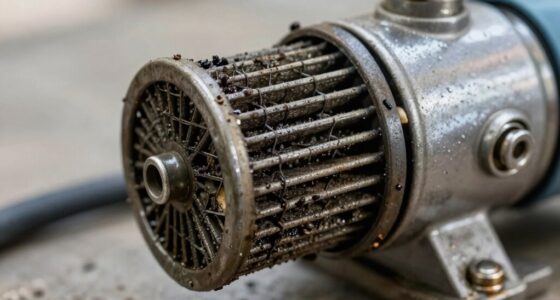

One of the most overlooked reasons your splitter won’t build full pressure is a partially closed valve or a clogged filter. These issues restrict hydraulic flow, making it hard for the pump to reach its full pressure capacity. You might notice reduced force or hesitation during operation. Regularly check and open valves fully, and inspect filters for blockages. Staying on top of these simple steps can often resolve pressure problems—continue to learn more about what might be holding you back.

Get business pricing on tools and workshop supplies
- Business-only prices and quantity discounts
- Tax-exempt purchasing
- Multiple users, one account, clear invoices
Key Takeaways
- Hidden or small leaks in hydraulic lines can silently prevent full pressure buildup.
- Partially closed or malfunctioning pressure relief valves restrict system pressure.
- Internal damage or wear in pump components reduces its ability to generate full pressure.
- Contaminants lodged in control valves can prevent proper pressure regulation.
- Improperly calibrated or faulty pressure gauges may mislead the assessment of actual system pressure.

Have you noticed your splitter isn’t building full pressure during operation? It’s frustrating, especially when you rely on it for efficient work. Often, the cause seems obvious—like a leak or an worn-out part—but sometimes the real issue is less apparent. One of the most overlooked reasons for a splitter’s pressure deficiency is a flow restriction within the hydraulic system. This isn’t always obvious at first glance, but it can seriously limit the pressure your splitter can generate and sustain. flow restriction occurs when something hampers the smooth movement of hydraulic fluid through the system. It could be a clogged filter, a partially closed valve, or debris blocking a line. When the fluid can’t flow freely, the hydraulic pump struggles to reach its full pressure capacity, which can be affected by system cleanliness, since contaminants often cause blockages or restrictions. Additionally, proper hydraulic system maintenance plays a critical role in preventing these issues and ensuring consistent pressure. Regular inspections and timely replacements of worn components help maintain hydraulic fluid flow and prevent restrictions. Instead of building up the necessary force, it stalls or operates at lower pressures, which directly impacts your splitter’s performance. Many operators overlook these subtle signs, assuming that mechanical failure or external damage is to blame when, in fact, it’s a simple restriction in the flow path.
As an affiliate, we earn on qualifying purchases.
Frequently Asked Questions
Can Temperature Affect Splitter Pressure Performance?
Yes, temperature affects splitter pressure performance. Temperature fluctuations can cause expansion or contraction of materials, impacting seal integrity and efficiency. If your splitter isn’t compatible with the operating temperature, it may not build full pressure or could leak. Always consider material compatibility with temperature ranges to guarantee peak performance. Properly managing temperature helps maintain consistent pressure and prevents potential damage or failure in your splitter system.
How Does Wear Impact Pressure Buildup Over Time?
Imagine a splitter used daily for years, and you’ll see wear degradation gradually hampers pressure buildup. As components wear, their ability to maintain pressure consistency diminishes, causing fluctuations or drops in pressure. Over time, this wear creates leaks or weak points, preventing the splitter from reaching full pressure. Regular maintenance and inspections can help identify wear early, ensuring peak performance and consistent pressure output.
Are There Specific Maintenance Routines to Improve Pressure?
To improve pressure, you should follow regular maintenance schedules and system calibration. Regularly inspect and clean components to prevent blockages and leaks, which hinder pressure buildup. Calibrate the system periodically to guarantee accurate pressure readings and peak performance. By sticking to these routines, you’ll maintain a reliable pressure level, reduce wear, and prevent issues that could cause pressure drops or system failure, ensuring your splitter operates efficiently over time.
Does the Type of Fluid Influence Pressure Issues?
Yes, the type of fluid influences pressure issues. Fluid viscosity plays a vital role—thicker fluids resist flow more, reducing pressure, while thinner fluids improve it. Additionally, fluid compatibility matters; using incompatible fluids can cause blockages or damage, impairing pressure build-up. To maintain ideal pressure, choose fluids with appropriate viscosity for your system and guarantee they are compatible with your splitter’s materials, avoiding potential malfunctions.
Can External Environmental Factors Cause Pressure Loss?
Like a ship steering through treacherous waters, you can’t ignore environmental interference when dealing with pressure loss. External contamination, such as dirt or moisture, can clog or hinder your splitter’s performance, leading to reduced pressure. Sudden temperature changes or wind can also impact pressure levels, causing fluctuations. Always make certain your system is protected from external factors, keeping it sealed and clean, so it maintains full pressure and operates smoothly.
Conclusion
If your splitter’s pressure feels like a deflated balloon, don’t ignore the simple fixes. Sometimes, the culprit’s hiding in plain sight—like a tiny leak or a clogged valve—sabotaging your progress. Think of your splitter as a finely tuned engine; neglecting small issues can stall the whole machine. Stay vigilant, check every nook and cranny, and restore that mighty pressure. After all, a well-tuned splitter is the roaring lion of your yard work, ready to conquer any task.
Fall yard work Picks
leaf blowers
As an affiliate, we earn on qualifying purchases.