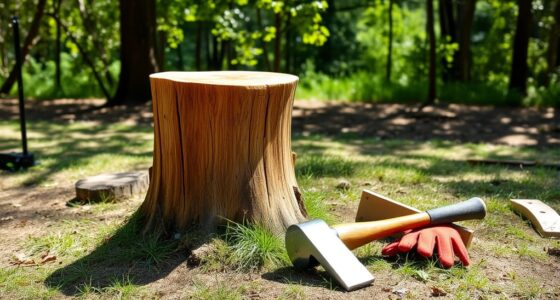
Logs twist when you split them because their internal grain patterns and knots cause uneven resistance, making the wood resist splitting straight and sometimes deflecting or warping. If the grain runs at an angle, twists, or there’s a knot, you’ll notice more twisting during the process. Understanding these factors can help you reduce surprises, so if you want to learn how to better anticipate and handle these issues, keep exploring further.

Get business pricing on tools and workshop supplies
- Business-only prices and quantity discounts
- Tax-exempt purchasing
- Multiple users, one account, clear invoices
Key Takeaways
- Irregular or wavy grain patterns resist straight splitting, causing logs to twist during the process.
- Knots create uneven internal structure, leading to deflection and twisting when splitting through these dense areas.
- Grain that runs at an angle or is misaligned increases resistance and can cause the log to twist as it splits.
- Internal irregularities in the wood, such as bends or twists in the grain, contribute to unpredictable twisting behavior.
- Forcing tools through knots or uneven grain without adjusting can cause logs to twist and warp during splitting.

Splitting logs can sometimes lead to twisting or warping, making the process more frustrating and difficult. When you’re trying to split wood, you might notice that the log doesn’t split straight down the grain as expected. Instead, it twists or warps, causing extra effort and potential damage to your tools. Understanding why this happens starts with paying attention to the wood’s grain orientation. The grain is the natural direction in which the fibers run through the wood. If you’re splitting along the grain, the process is usually smooth and predictable. But when the grain runs at an angle or twists within the log, it becomes much more resistant to splitting, often causing the wood to twist or bend unexpectedly. This is especially true if the grain is not straight but wavy or irregular, which can happen in certain species or with logs that grew under specific conditions.
Knot influence plays a significant role in how a log behaves during splitting. Knots are areas where branches once grew, and they create dense, irregular spots in the wood. These knots disrupt the uniformity of the grain and introduce weak points that can cause the log to split unevenly. When you hit a knot during splitting, the force may cause the wood to deflect or twist as it encounters these dense, unpredictable areas. This effect is amplified if the knot is located near the surface or embedded deep within the log, making the splitting process more unpredictable. The presence of knots can also change the direction of the split, forcing it to deviate from a straight path along the grain and resulting in twisting or warping.
To minimize these issues, you should assess the grain orientation before splitting. Look for straight, evenly aligned grain patterns—these will split more cleanly and with less twisting. If you encounter knots, plan your split to avoid forcing the blade through them directly, or split around them if possible. Using proper tools, such as a sharp splitting axe or maul, helps apply force more accurately along the grain, reducing the chances of twisting. Additionally, grain orientation can be affected by the tree’s growth conditions, which influence the internal structure of the wood. Ultimately, understanding how grain orientation and knot influence the log’s internal structure can help you anticipate and prevent twisting, making your splitting efforts more efficient and less frustrating.
As an affiliate, we earn on qualifying purchases.
Frequently Asked Questions
Do Different Types of Wood Twist More Than Others?
Yes, different types of wood twist more than others. You’ll notice that woods with irregular or uneven wood grain, like oak or walnut, tend to twist during the drying process. When you split these logs, the uneven grain causes internal stresses to develop as they dry, leading to twisting. To minimize this, you should split the logs properly and let them dry slowly, which helps reduce the risk of warping.
Can Moisture Content Influence Log Twisting?
Moisture content definitely influences log twisting. When moisture variation occurs within the wood, it causes uneven wood shrinkage as it dries, leading to twisting or warping when you split the logs. If a log has uneven moisture levels, some parts shrink more than others, creating internal stresses that result in twisting. To minimize this, guarantee logs are properly dried and stored in consistent humidity conditions before splitting.
Does the Age of the Tree Affect How Logs Twist?
You’ll find that older trees tend to produce logs with more unpredictable twists because their wood grain becomes more complex over time. Studies show that as trees age, their bark removal reveals intricate grain patterns, which influence how the wood splits. When splitting logs, understanding the age helps you anticipate twisting—especially if you’re working with seasoned, mature wood, where grain direction and bark removal considerably impact the outcome.
Are There Tools That Reduce Log Twisting During Splitting?
Yes, there are tools that reduce log twisting during splitting. Using specialized splitting tools like mauls with a sharp, well-maintained blade helps you apply force more effectively, minimizing twisting. Additionally, employing proper log handling methods, such as stabilizing the log and choosing the right splitting techniques—like splitting along the grain—ensures you split logs cleaner and straighter, reducing the chances of twisting and making your work safer and more efficient.
How Does Log Shape Impact Twisting Tendencies?
If you’ve noticed logs twisting when splitting, it’s often due to the shape and grain alignment. For example, a log with uneven grain or irregular fiber direction is more prone to twisting. When you split along the grain, the fiber direction influences how the wood splits, reducing twisting. Conversely, splitting against the grain or through irregular grain can cause the log to twist, making your job tougher.
Conclusion
Now, imagine the logs you’ve carefully split suddenly twisting in your hands, as if alive with a secret. The cause isn’t just about grain or moisture—there’s more beneath the surface. Could it be hidden forces, unseen fractures, or something else entirely? The next time you split a log, pay close attention. What mysteries lie within each twist, waiting to reveal themselves? The answer might just change the way you see every piece of wood forever.
Fall yard work Picks
leaf blowers
As an affiliate, we earn on qualifying purchases.