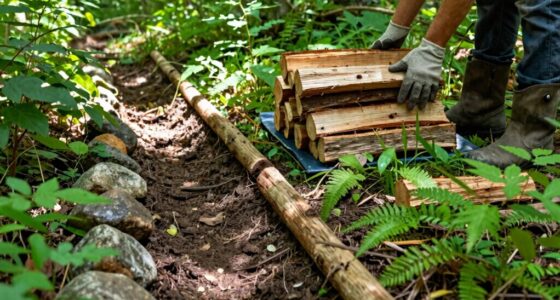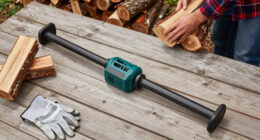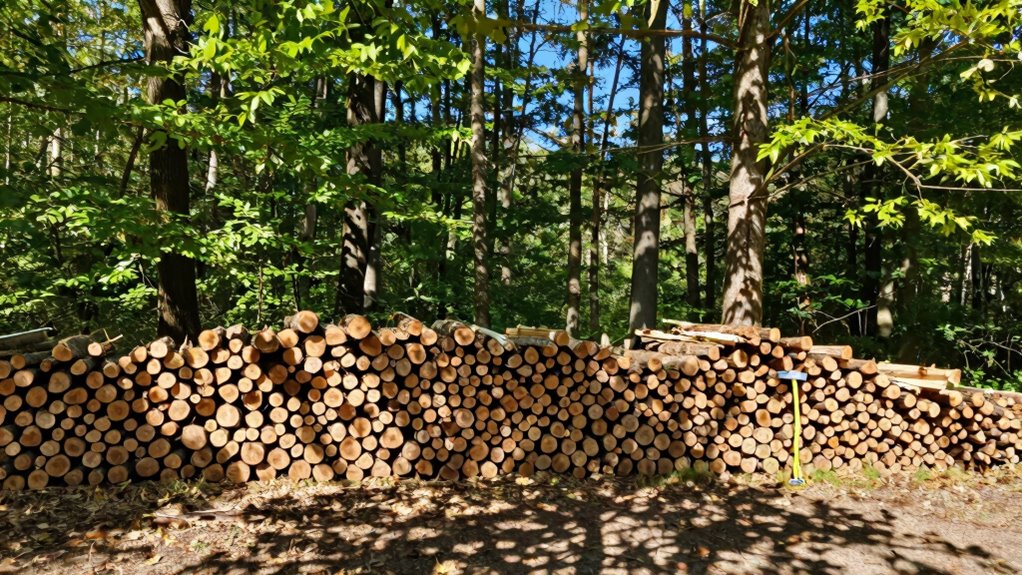

To easily estimate your firewood supply, start by measuring the diameter of your trees at chest height and noting their heights. Use a simple formula—diameter times height times a conversion factor—to get an approximate volume in cords or cubic meters. Focus on trees designated for harvesting and consider how drying time impacts usability. If you’re curious about refining your estimate and managing your land sustainably, there’s more helpful information ahead.

Get business pricing on tools and workshop supplies
- Business-only prices and quantity discounts
- Tax-exempt purchasing
- Multiple users, one account, clear invoices
Key Takeaways
- Measure trunk diameter at chest height and tree height for accurate volume estimates.
- Use a simple formula: diameter × height × conversion factor to approximate firewood volume.
- Identify and focus on trees designated for sustainable harvesting to avoid overcutting.
- Calculate the total volume of harvestable trees, considering efficiency in cutting and splitting.
- Account for seasoning time, as dried firewood provides better heat and reduces volume estimates.
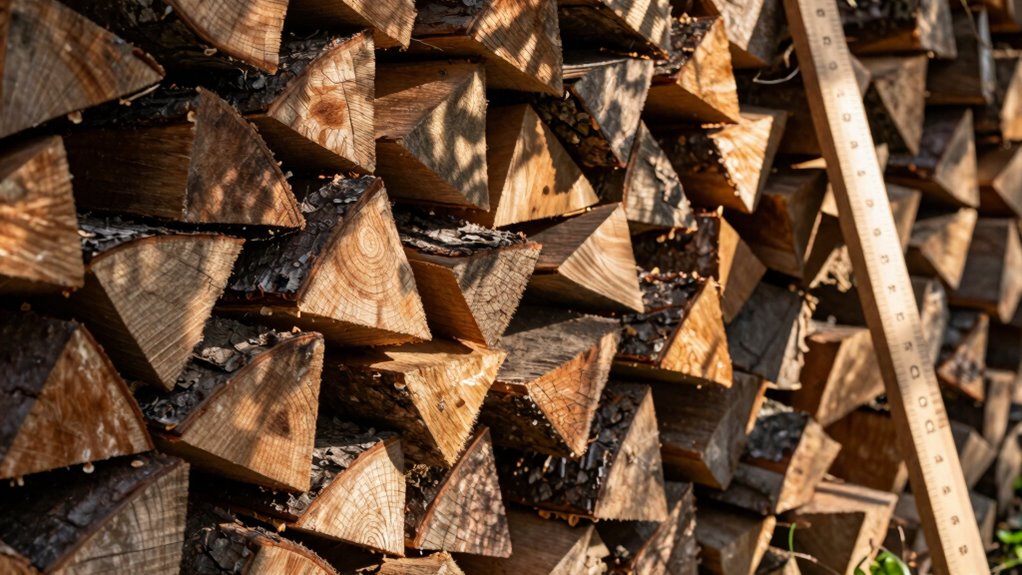
Have you ever wondered how to accurately estimate the amount of firewood you can harvest from your land? Knowing this upfront helps you plan better, avoid overharvesting, and guarantee your supply lasts through the winter. The key lies in understanding how much firewood your property can produce without damaging the environment. To do this easily, you need to contemplate a few straightforward factors, starting with the types of trees present and their sizes. Measuring the volume of these trees is an efficient way to get a rough estimate, especially if you focus on those designated for sustainable harvesting. Remember, sustainable harvesting means taking only what you need and leaving enough trees to regenerate, which keeps your land healthy and productive for years to come.
Once you’ve identified the trees, the next step is to weigh how you’ll process the wood. Cutting trees into manageable sections, or rounds, makes estimating easier. A good rule of thumb is to measure the diameter of the trunk at chest height; larger diameters generally mean more firewood. Using a simple formula, you can approximate the volume of firewood produced by multiplying the tree’s diameter, height, and a conversion factor. This gives you a rough estimate in cords or cubic meters. Keep in mind, the actual yield depends on how efficiently you cut and split the wood. Additionally, understanding sustainable harvesting practices ensures you maintain healthy forests while maximizing your firewood supply. It’s also helpful to familiarize yourself with forest management principles to support long-term productivity.
Firewood drying plays a vital role in estimating usable firewood. Freshly cut wood contains moisture, which reduces its heat output and increases the risk of creosote buildup in your chimney. Proper firewood drying, or seasoning, involves stacking the wood in a way that promotes airflow and allows moisture to evaporate. Typically, seasoned firewood needs about six to twelve months to dry thoroughly, depending on the climate. When estimating your harvest, consider how much of your wood is already dried or will need drying time. This impacts the actual amount of firewood ready for use and helps you plan your harvesting schedule more accurately.
As an affiliate, we earn on qualifying purchases.
Frequently Asked Questions
How Does Tree Species Affect Firewood Yield?
Tree species considerably affect firewood yield because different types vary in density and bark thickness. Denser species like oak produce more burnable wood per volume, while softer woods like pine yield less. Tree density influences how many trees you can harvest, and thicker bark can indicate older, more mature trees with better firewood quality. Understanding these factors helps you estimate your property’s firewood potential more accurately.
What Tools Are Best for Measuring Tree Volume?
You should use a diameter tape or calipers to measure the tree’s diameter at breast height, then estimate the tree height with a clinometer or a measuring pole. Consider bark thickness, as thicker bark can affect volume calculations. Combining these measurements gives you a good estimate of the tree’s volume. For more accuracy, use a tree volume calculator or form class charts that factor in bark thickness and tree height.
How Often Should I Estimate Firewood Production?
Frequent firewood estimates foster fruitful firewood storage and seasonal harvesting. You should assess your firewood production at least once or twice per season, ideally before and after harvesting. This regular review helps track growth, plan cutting schedules, and prevent overharvesting. By staying proactive with your estimates, you guarantee a steady supply of seasoned firewood, maximizing your property’s potential and maintaining sustainable harvesting habits throughout the year.
Does Soil Quality Influence Firewood Growth?
Yes, soil quality impacts firewood growth. Rich soil with ample soil nutrients promotes healthy tree development, resulting in better firewood. Conversely, poor soil can stunt growth or cause trees to become weak. Implement erosion control measures to prevent soil loss, which helps maintain soil quality. Healthy soil supports strong, dense trees, increasing your firewood yield and ensuring sustainable harvesting. Regularly evaluating and improving soil conditions benefits your firewood production in the long run.
Can I Estimate Firewood From Fallen Branches?
Yes, you can estimate firewood from fallen branches. Measure the branch diameter to gauge how much usable wood you have. Thicker branches generally yield more firewood, while thinner ones might be better for kindling. Collect fallen wood regularly, and by estimating the total volume based on branch sizes, you can get a good idea of your firewood supply. This approach helps you plan your firewood needs efficiently.
Conclusion
By estimating your firewood potential, you can better plan for the colder months and save money. Did you know that a mature tree can yield up to 1 cord of firewood? That’s enough to heat a small home for an entire winter! With a simple calculation, you can confidently determine how much firewood your property can produce, ensuring you’re prepared and making the most of your land’s resources.
Fall Picks
fall essentials
As an affiliate, we earn on qualifying purchases.